Who owned the street: how Montevideo's shared roadway was divided, in photographs
In the United States, the street's surrender to the car has a documented villain — an organized campaign that redefined walking as trespassing. Montevideo's archive tells a different version: the same ending, no villain found. Five photographs and a handful of numbers show a shared street being sorted, piece by piece, into the order we now mistake for natural.
Start with the American story, because it sets a trap. The historian Peter Norton showed how, in 1920s America, motoring interests ran organized campaigns to push pedestrians off the roadway — inventing the offence of "jaywalking" to do it. It's tempting to assume every city lived that story. So we went looking for Uruguay's version in the digitized press of the period — and, as far as that record can be searched, it isn't there. No campaign, no coined word, no crusade against the walker. Hold that absence; the photographs make it interesting.
What the street was. In 1880, Plaza Independencia belongs to carriages. In 1900, at Rincón and Bartolomé Mitre, pedestrians walk the cobbled roadway itself, nowhere near a curb — by habit, and by right nobody had yet thought to question. And in 1908, at Agraciada and Lucas Obes, one municipal photograph performs an accidental census: electric tram, carriage, parked automobile, walking pedestrians — four claimants, one undivided surface, no one out of place.
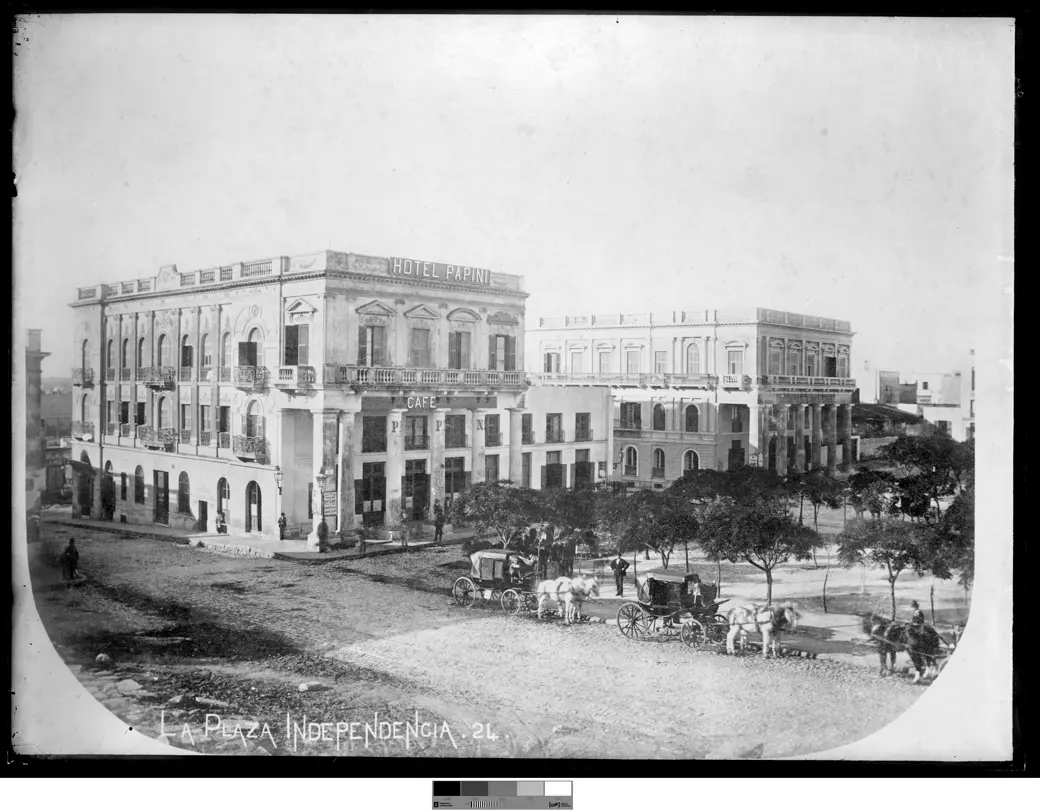
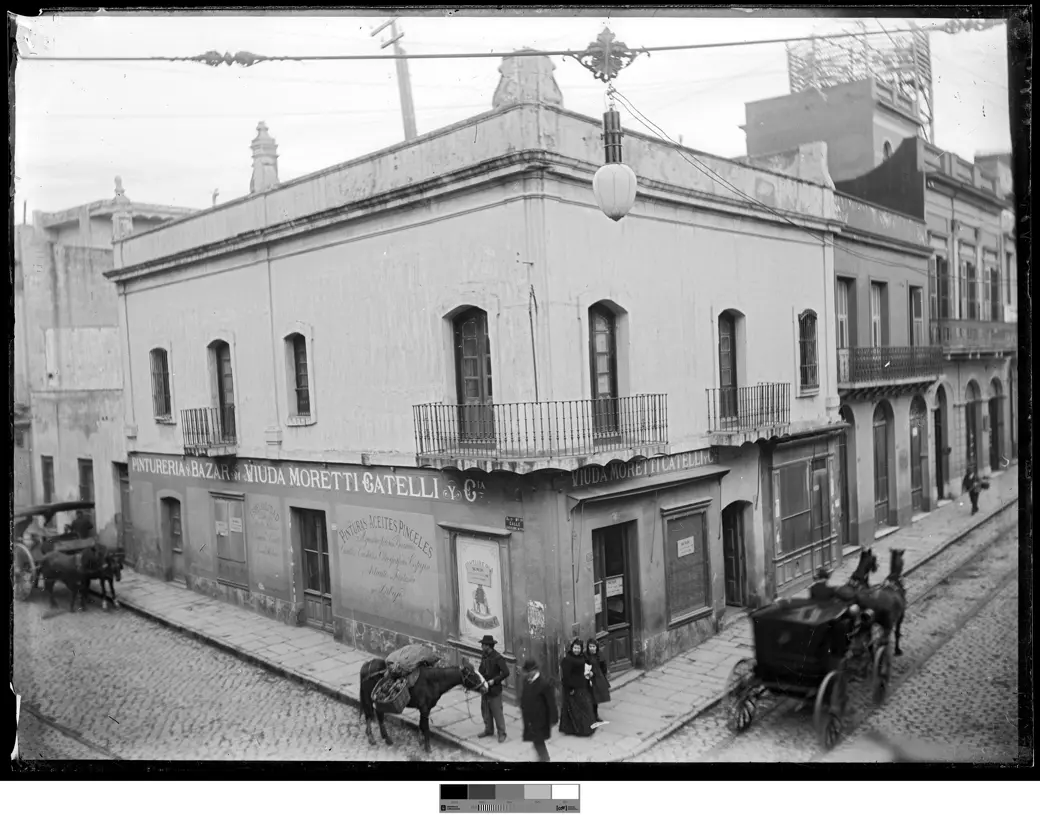
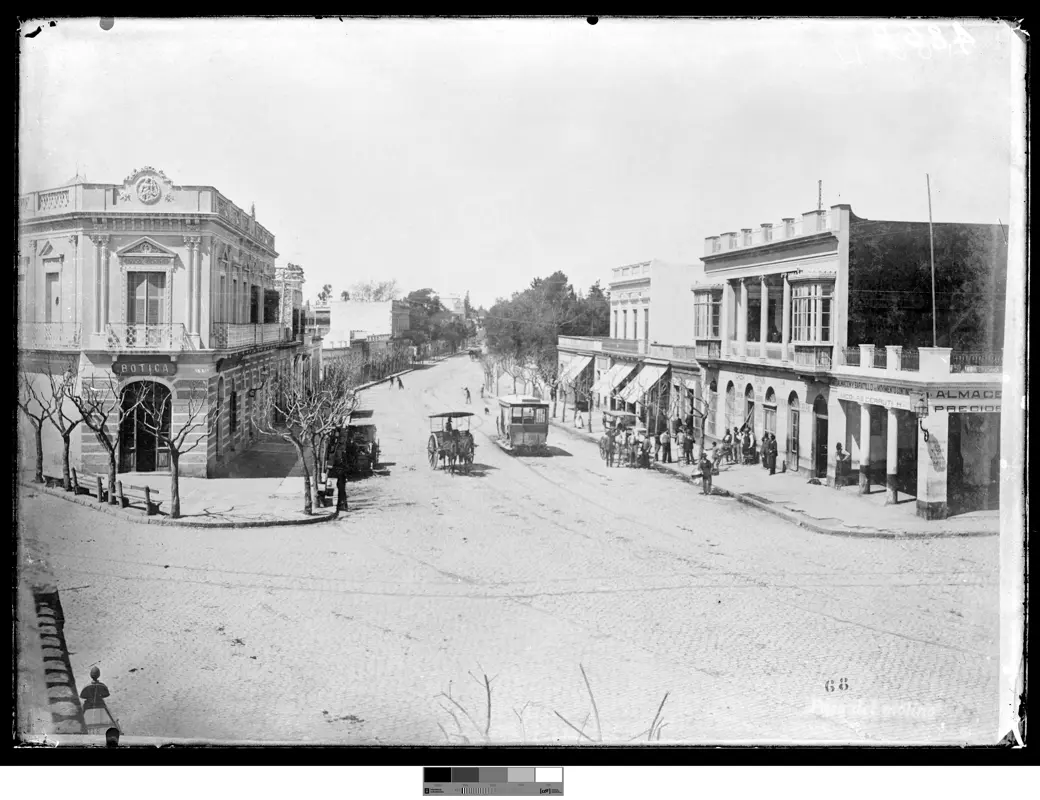
The car arrives, with numbers attached. The measurable part begins in 1904, when Alejo Rossell y Rius imported a single-cylinder Delin — the country's first confirmed automobile, and the same machine that would later ride the Fiesta de la Locomoción as a relic. The historians Barrán and Nahum tracked what followed through the traffic counts: 0.39 percent of Montevideo's traffic in 1905; 9.76 percent by 1916, a share that by then, in their words, on its own "nearly equalled the coupés, breaks and volantas combined." The city's paperwork ran behind its own streets — as late as 1905, the municipal road plan was still costing pavement wear by cart and stagecoach.
Many claimants, not two. Framing this as car versus pedestrian misses how crowded the field was. The bicycle got organized first — from late 1904 the Club Nacional de Velocipedistas was installing roadside toolboxes, and from 1905 petitioning for road signage, more than a decade before motorists founded their Automóvil Club. And the era's noisiest street fight involved neither walkers nor drivers; it came in two acts. The state tried buses first, running its own experiments through the public-works ministry between 1911 and 1919, without success. The wave that stuck was private and informal: from around 1925 the "colectivos" ran unregulated — tram companies protesting, the traffic directorate looking on — until the city formalized them in 1926. Street access was being settled clause by clause, office by office. Nobody wrote a manifesto.
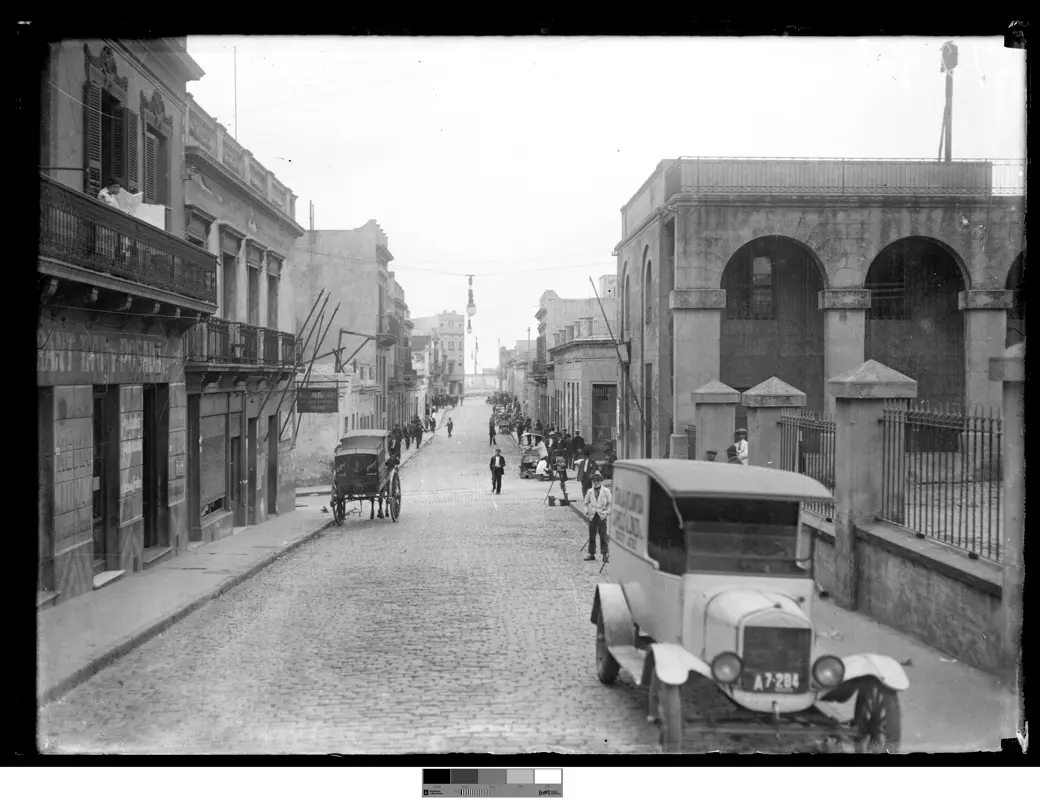
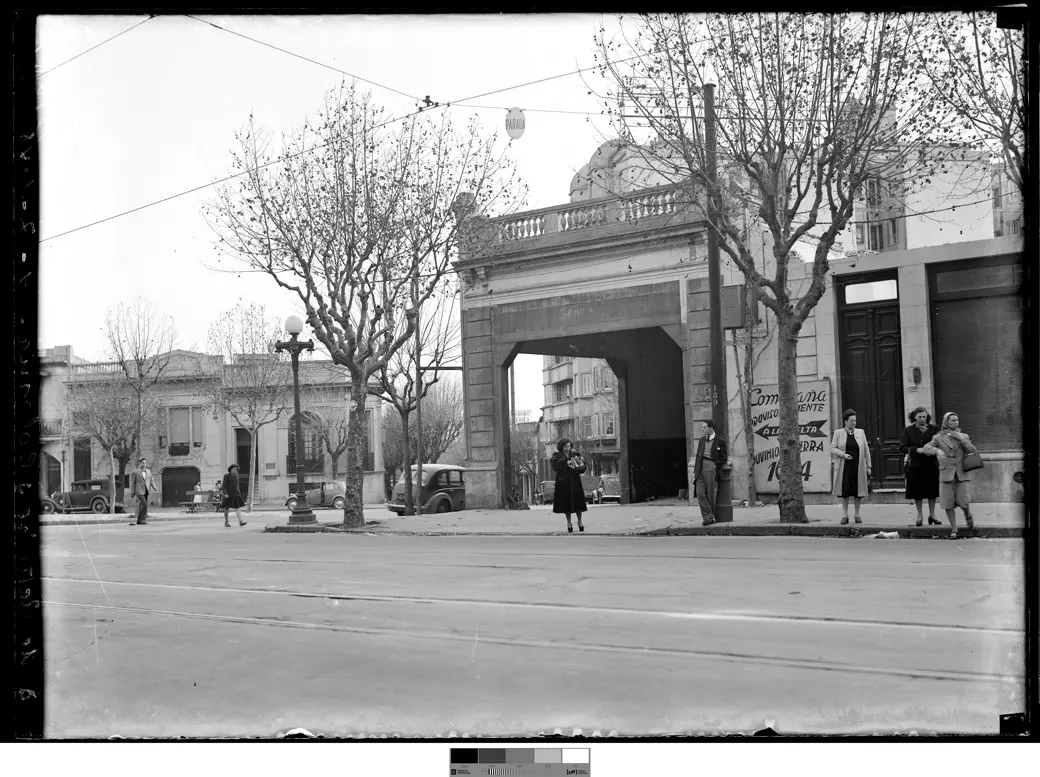
The sorting, photographed. Two frames, years apart, tell it. Calle Yerbal, 1920: a motor truck and a horse carriage share the block, and pedestrians take the middle of the roadway as if it were still theirs — because it still was. Tres Cruces, a long stretch later: every car aligned at the curb, every walker up on the sidewalk or the plaza's rim. Between those two photographs there is no single law to point at. Just an order settling in, layer on layer.
A street is never done being divided. If the archive proves one thing, it's that no division of the roadway has ever been final. Cart gave way to tram, tram to bus, bus to car — and at each handover the new arrangement looked eternal until it wasn't. The city knew this about itself: it paraded its own mode-history three times, medals included. Today's bike lane down the axis of 18 de Julio belongs to that long series — one more redivision of a surface that has never stopped being negotiated.
- Eduardo Bertiz (2025). Urban Mediators: Meta-project Experimentation on Montevideo's Rambla (doctoral thesis, FADU-UdelaR), Ch. 9 — the first automobile (1904), the 1905 road plan, Barrán and Nahum's traffic-share figures (0.39% in 1905 to 9.76% in 1916), and the chronology of the state bus experiments (1911–1919) and the informal colectivos (from 1925, formalized in 1926). Read the thesis. Accessed Aug 1, 2026
- "Historia del Ómnibus en Montevideo." Montevideo Antiguo — an independent chronology of the state bus experiments and the informal colectivos. Read the article. Accessed Aug 1, 2026
- "Historia." Automóvil Club del Uruguay — the club's founding (June 12, 1918), first board, and international recognition. Read the institutional page. Accessed Aug 1, 2026
All five photographs are public-domain (CC0) records from the Centro de Fotografía de Montevideo (CdF), Fondo Municipal Histórico. The fifth plate (inv. 1088FMHB) carries no date in the catalogue; we haven't assigned one.