When streets belonged to children
Twice in Montevideo's municipal photo archive, a street is the children's for a day: under a shower rigged over the roadway in 1940, and in a Carnival parade in 1966. A third photograph, from 1942, shows a lawn with swings in a Plaza de Deportes, a public sports ground. This is what the three frames show, what their catalogue records say, and what those records leave out.
Two days, and a lawn. In a photograph from 1940, a shower is rigged over a roadway in Montevideo, and boys stand under it, some in swimming trunks, while a crowd packs in around them. In another, from 1966, children in costume dance in the middle of a roadway in a Carnival parade. Those are two documented days when a street was the children's, and the sources cited here do not make them an era. A third picture, from 1942, shows a lawn with swings. All three come from the Centro de Fotografía (CdF), Montevideo's municipal photography archive, which holds photographs produced by the Intendencia de Montevideo, the departmental government. Each has a catalogue record: a title, a date, keywords.
1940: a shower over the roadway. Seen from above, a curtain of water falls onto the middle of the roadway. A handful of boys stand in the wet patch beneath it, some in swimming trunks, one in shorts and braces, and the rest of the street is packed with onlookers. Towards the far end, behind the crowd, a man stands on the bed of a truck, near men in peaked caps, at least one of them holding a brass horn.1
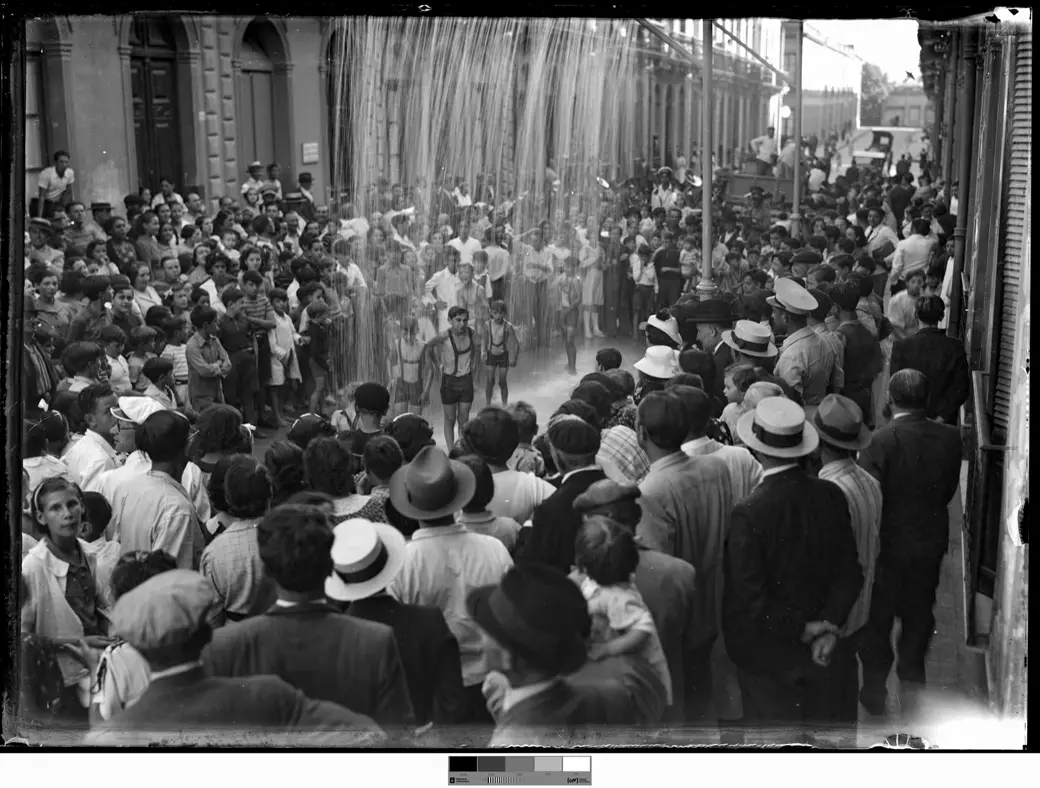
The record: a title, a year, a keyword. The catalogue titles the picture "Baños callejeros", street baths, and places it on Emilio Reus street, between Domingo Aramburú and Blandengues. Its date is the year alone, 1940, and no photographer is named. Its keywords include water, recreation, free time, public, and Carnival.1 Nothing on the record says who put the shower there, what the occasion was, or what time of year it was. The keyword stays a keyword: it does not explain the scene.
A second photograph of the same street, catalogued under the same year, stands further back and shows the apparatus: a curved frame of metal pipe arching over the roadway, a sheet of water falling from it and, in the foreground, a low barrier of wooden rails closing the street. This one is titled "Juegos de agua", water games, and its keywords include ducha and verano, shower and summer.2 That is the nearest the catalogue comes to naming a season.
The same kind of structure appears two years earlier. On 2 February 1938 it was photographed in Piedras Blancas, another Montevideo neighbourhood: the curved overhead pipe, the wooden barrier across the road, children under the water. One of those frames is titled "Baños públicos en Piedras Blancas", public baths.3 Another record of the same date is titled "Baños públicos en Villa Muñoz".4 What the frames establish is narrow: the same kind of apparatus, in at least two neighbourhoods, in 1938 and again in 1940, each time in a photograph produced by the Intendencia. Whether it went up every year, and on whose orders, the records do not say.
What is on record about play in the street. Nothing in the sources makes the 1940 frame an ordinary afternoon. What they do place in Montevideo's streets, where games are concerned, is football. Yamandú González Sierra, in a passage quoted in a 2018 study by Inés Scarlato, writes of children and young people at the start of the twentieth century who took up the game "in the patios, streets and vacant lots" of Montevideo.5 Rodolfo Porrini, writing about the 1920s, has thousands of workers and their families "of all ages, from adulthood to childhood" playing it in stadiums, on pitches, on scraps of open ground and in streets.6 A catalogue frame dated, approximately, to the 1940s shows four boys and a ball in the residential neighbourhood of Punta Carretas, on a roadway they share with tram tracks, a parked car and a number 35 tram behind them.7 And a memoir by Carlos Parada, published in 2022 on the website of the Fundación Barrio La Mondiola, recalls a 1950s policeman in that Montevideo neighbourhood, nicknamed El Lenteja, who was "famous for coming to chase us when we were playing ball in the street".8
That is four sources and one game. The street appears in them alongside patios, vacant lots and pitches, and none of the four puts any other game in the roadway. New York has a count of the children on its streets: in April 1913, by the People's Institute's report, about four hundred civic workers "carefully drilled in advance" surveyed the streets of Manhattan and "classified a total of about 110,000 children".9 For Montevideo the sources cited hold no count, either of children in the street or of how often, and on how many streets, the game was played.
The State's project, in the same years. Law No. 3439 of 7 July 1911 created the Comisión Nacional de Educación Física, a national commission for physical education that answered to the executive.56 In 1913 the commission opened its first plaza vecinal de cultura física, a neighbourhood ground for exercise and games, on land in Ciudad Vieja, the city's historic core, lent by Francisco Piria.10 On 7 April 1915 a resolution gave the grounds a new name, Plaza de Deportes, a sports plaza, and numbered them one to three.10
They were not meant for children alone. Juan Arturo Smith, the commission's first president, wrote in 1913 that the plazas were "not only for children or adolescents": mothers, fathers, the young and the old could come too, to watch their children exercise or to exercise themselves.5 By the commission's stated aims, children were to come for air, sun and water, for running and free exercise; adolescents and men were to be drawn away from "unwholesome gatherings", from the horse-racing clubs, the cafés and the street corners.10 Smith's main point of comparison was the American playground, and he wrote of going further than the "wise sister to the north": the plazas, he claimed, had "a far more perfect and far broader organisation", open to every age and run by competent directors and teachers.5
Scarlato reads the plazas' football ground as aimed at the same children and young people who were taking up the game in patios, streets and vacant lots. The promoters' own words, as quoted in the two studies, do not describe the plazas as a way of getting children off the roadway; the one street-related word among their stated aims is esquinas, the corners where men gathered.510
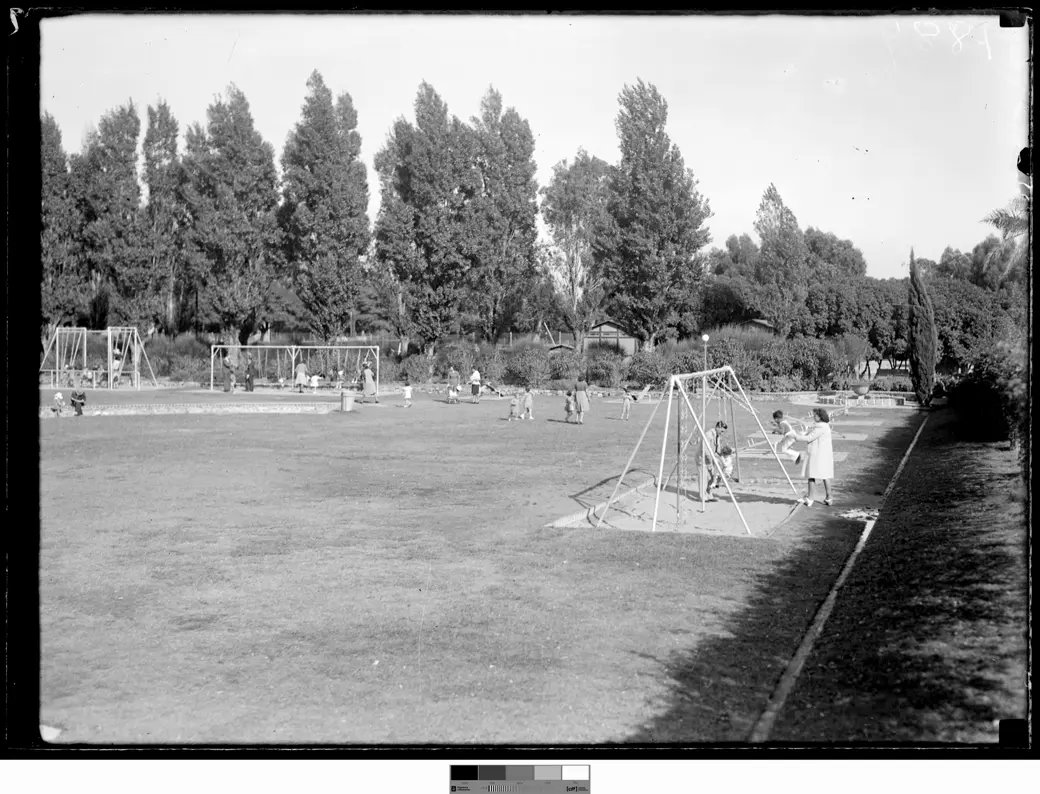
1942: a lawn and swings in Parque Rodó. The third of the renamed grounds, Plaza de Deportes No. 3, was the commission's sports field in the Parque Urbano, inaugurated under the new name in October 1915.10 Parque Urbano was the original name of Parque Rodó, a park near Montevideo's coast whose first works date from the opening years of the century.11 The second of the three photographs was taken there in 1942, twenty-seven years on: a wide mown lawn, swing sets, the nearest on sand, small children with adults. The record gives the place and the year. It does not say who built what is in the picture, or why.12
1966: a parade with no address. The third photograph is a 35 mm negative from 1966 by Miguel Paternostro Graciosi, catalogued as "S.i. Desfile infantil de Carnaval": a children's Carnival parade, with "S.i." standing for a place the catalogue has not identified.13 Three small children in costume are dancing in the middle of a wide asphalt roadway, with a line of older children and young people in ruffled costumes behind them and a dense crowd along one side.
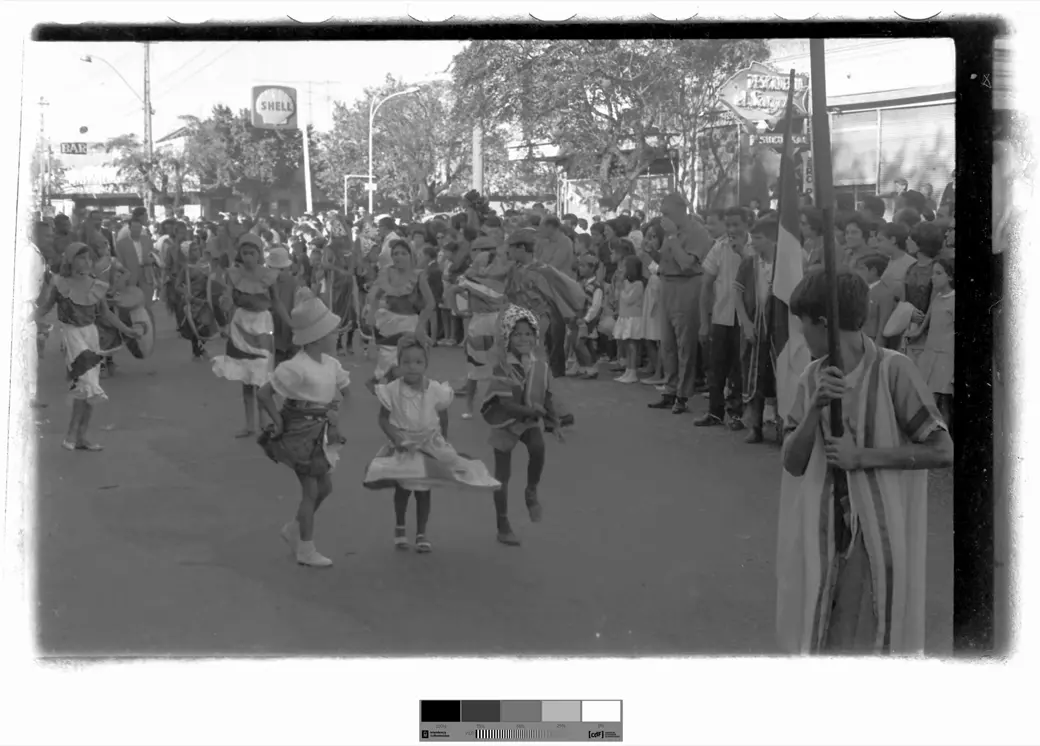
Twenty-six years after the shower on Emilio Reus street, a roadway is the children's again: a parade has put them there, and a crowd is watching.
Counting the records. In the Intendencia's photographic series, the records tagged with the keyword Niño, child, number 43 of the 515 dated to the 1940s, 7 of the 249 from the 1950s and 3 of the 95 from the 1960s (including records with approximate dates), as the catalogue stood on 4 October 2026.14 That is about one record in twelve, then one in thirty-six, then one in thirty-two, the last resting on three records. The series itself thins, from 515 records to 95. A record counts if it carries that one keyword, and the keyword is also attached to ceremonies and parades. And three records out of 95 are too few to bear weight. These are counts of the photographs the Intendencia produced and how they were catalogued. They cannot show what children did in the street.
Where the record stops. On the days these photographs record, a street was the children's: under the water in 1940, in costume in 1966. Both were occasions with an audience. Of ordinary days the sources record far less: football, mentioned in passing across half a century, and one frame of approximate date. If there was a moment when the children of Montevideo were moved off the roadway, the sources cited record no decree, edict or date for it.
What remains is to look. All three photographs are in the CdF's online catalogue under the inventory numbers printed beneath them, in the public domain and at high resolution.15 Opened at full size, the 1966 frame has three signs in it: Shell on a tall pole, BAR, and a fishmonger's sign in the shape of a fish. Which street they stood on, the catalogue does not say.
- Centro de Fotografía de Montevideo (CdF), catalogue record 12548FMHGE, "Baños callejeros. Emilio Reus entre Domingo Aramburú y Blandengues." (1940). View the record Accessed 4 · OCT · 2026
- CdF, catalogue record 1610FMHB, "Juegos de agua. Emilio Reus esquina Domingo Aramburu." (1940). View the record Accessed 4 · OCT · 2026
- CdF, catalogue records 1608FMHB, "Calle Dunant y Camino Cuchilla Grande (posteriormente Avenida José Belloni).", 2 February 1938, View the record, and 23391FMHGE, "Baños públicos en Piedras Blancas.", 2 February 1938, View the record Accessed 4 · OCT · 2026
- CdF, catalogue record 23387FMHGE, "Baños públicos en Villa Muñoz.", 2 February 1938. View the record Accessed 4 · OCT · 2026
- Inés Scarlato, "Plazas Vecinales de Cultura Física/Plazas de Deportes. 'Templos laicos' de la ciudad batllista de Montevideo (1911-1918)", Rev. Iberoam. Patrim. Histórico-Educativo (RIDPHE_R, Campinas), v. 4, n. 1, Jan–Jun 2018, pp. 62–79. Open full text. Read the article Accessed 4 · OCT · 2026
- Rodolfo Porrini, "Izquierda uruguaya y culturas obreras. Propuestas al 'aire libre': el caso del fútbol (Montevideo, 1920-1950)", Diálogos (Maringá), v. 16, n. 1, Jan–Apr 2012, pp. 69–95. Read the article (PDF) Accessed 4 · OCT · 2026
- CdF, catalogue record 25086FMHGE, "S.i. Calle José Luis Zorrilla de San Martín y Rambla Gandhi." (1940s, approximate). View the record Accessed 4 · OCT · 2026
- Carlos Parada, "El milico Machado 'El Lenteja' patrullando La Mondiola", website of the Fundación Barrio La Mondiola, 23 March 2022. Read the article Accessed 4 · OCT · 2026
- John Collier and Edward M. Barrows, The City Where Crime Is Play, New York: The People's Institute, January 1914, p. 27. Read the article Accessed 4 · OCT · 2026
- Inés Scarlato, "Tiempos, espacios y sensibilidades urbanas: plazas vecinales de cultura física/plazas de deportes en Montevideo (1911-1918)", Trama, n.º 10, 31 December 2019, pp. 9–21 (the journal's record titles it «Montevideo escenario de una nueva política…»). Read the article Accessed 4 · OCT · 2026
- Intendencia de Montevideo, "Parque Rodó". Read the article Accessed 4 · OCT · 2026
- CdF, catalogue record 07884FMHGE, "Plaza de Deportes número 3 del Parque Rodó." (1942). View the record Accessed 4 · OCT · 2026
- CdF, catalogue record 10978FMHGE, "S.i. Desfile infantil de Carnaval." (1966), photograph by Miguel Paternostro Graciosi. View the record Accessed 4 · OCT · 2026
- CdF online catalogue, search "niños" (555 results on 4 · OCT · 2026). Count by decade of the record's date, only the General and A–G series of the Fondo Municipal Histórico (4,644 records), approximate dates included; in the 1940s, 1950s and 1960s every record returned carries the keyword «Niño». View the search Accessed 4 · OCT · 2026
- CdF, "El archivo histórico disponible en alta resolución" (licence statement: CC0 1.0 Universal). Read the article Accessed 4 · OCT · 2026
The three photographs are public-domain (CC0) records from the Centro de Fotografía de Montevideo (CdF), Fondo Municipal Histórico.