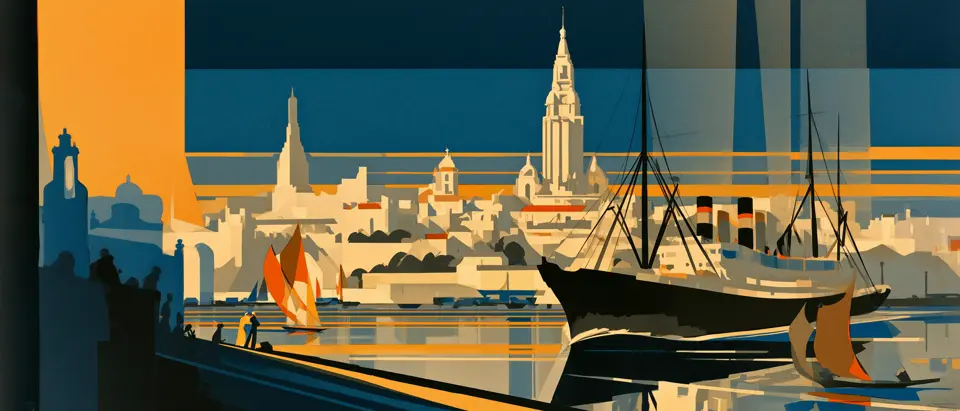
First came the harbour
On the morning Montevideo inaugurated its new port — 25 August 1909, after eight years of French-contracted works — a steamship lay wrecked at the brand-new entrance, and the ceremony went ahead anyway. Five archive plates tell how the city rebuilt its bay in stone and concrete, and why everything else follows from it.
Begin on the worst possible morning. The lighthouse on the Sarandí breakwater had been lit the evening before, on 24 August 1909; the port's inauguration was set for the 25th; and in the earliest hours of that same day the steamer Colombia was lost entering the roadstead — lives went with her. The chronicle records a ceremony held on schedule and enjoyed by no one. Eight years of works deserved a better party. They had already changed the city for good.
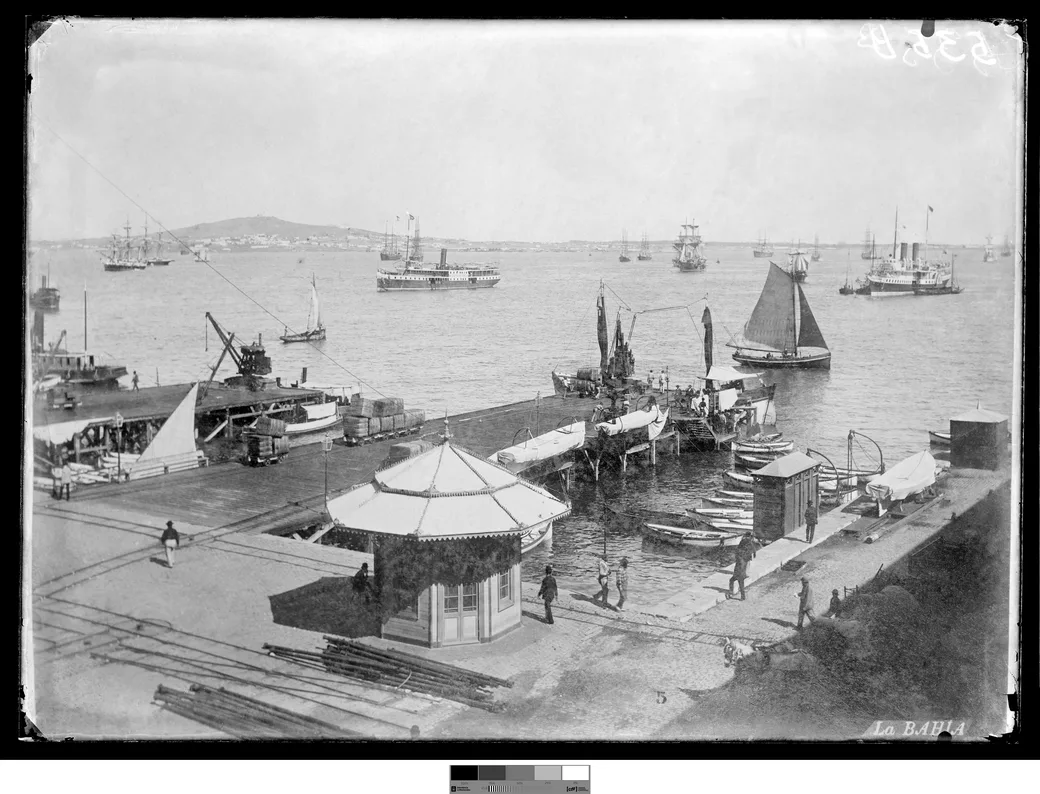
Rewind to the empty bay. The reason there is a Montevideo at all is the sheltered water beside it — the anchorage Zabala claimed in 1724 to keep the Portuguese off the same bay. More than a century and a half later, the shelter was still doing its work unassisted — an 1890s plate catches working sail moored beside early steamships, in a bay the engineers hadn't yet reached. The only built precedent was private and narrow in purpose — the Mauá dry dock of 1872, made for repairing ships, not for trading cargo.
A law, five bidders, one contract. The modern port began in Parliament. Works up to twelve and a half million Uruguayan pesos of the day were authorized by the law of 7 November 1899, and five foreign firms came to bid. When the commission ruled, on 2 January 1901, it passed over the marginally cheaper offer — Schneider's, sunk by defective legal powers — and recommended the French consortium of Allard, Coiseau, Couvreux, Duparchy and Wiriot, the engineer Jules Dollfus signing on their behalf. President Juan Lindolfo Cuestas put his name to the contract on 18 January 1901: seven years to build, two hundred francs of penalty for every day late.
A lead box under the first stone. That July the ceremony came to the foot of Calle Sarandí, where the eastern breakwater would spring. Ministers and legislators put their names to a foundation act; a lead box swallowed it; the first block went down on top, harbour craft sounding and bands playing. Then the bay disappeared behind machinery.
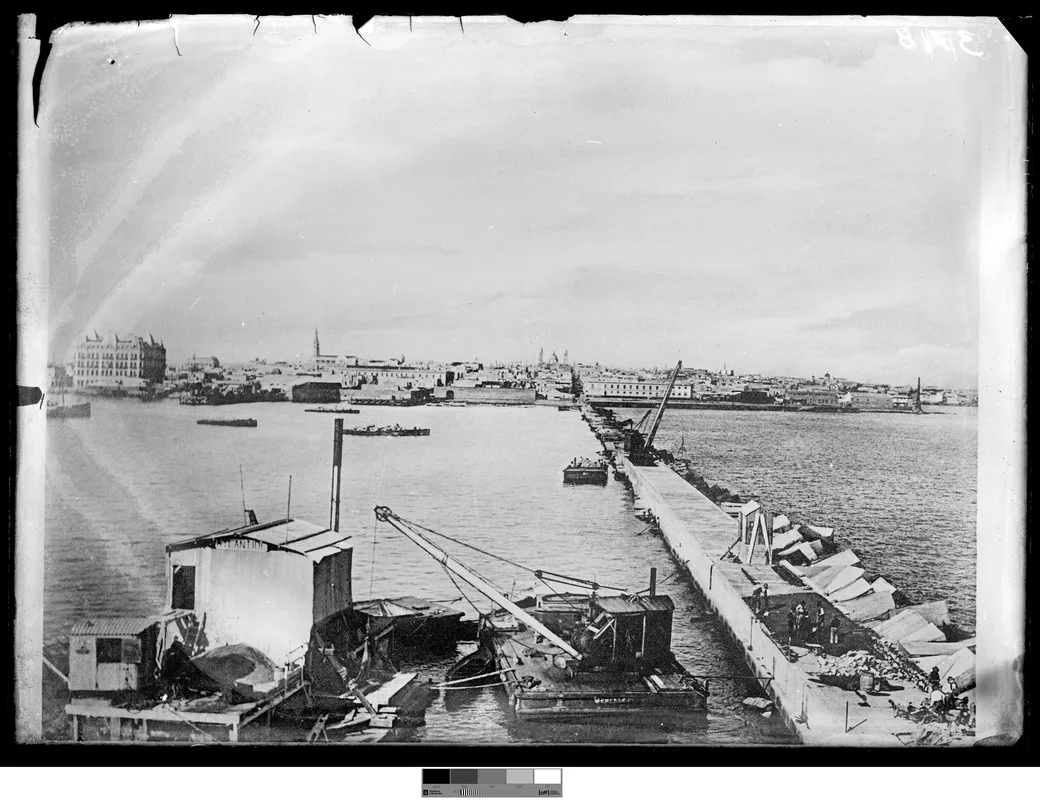
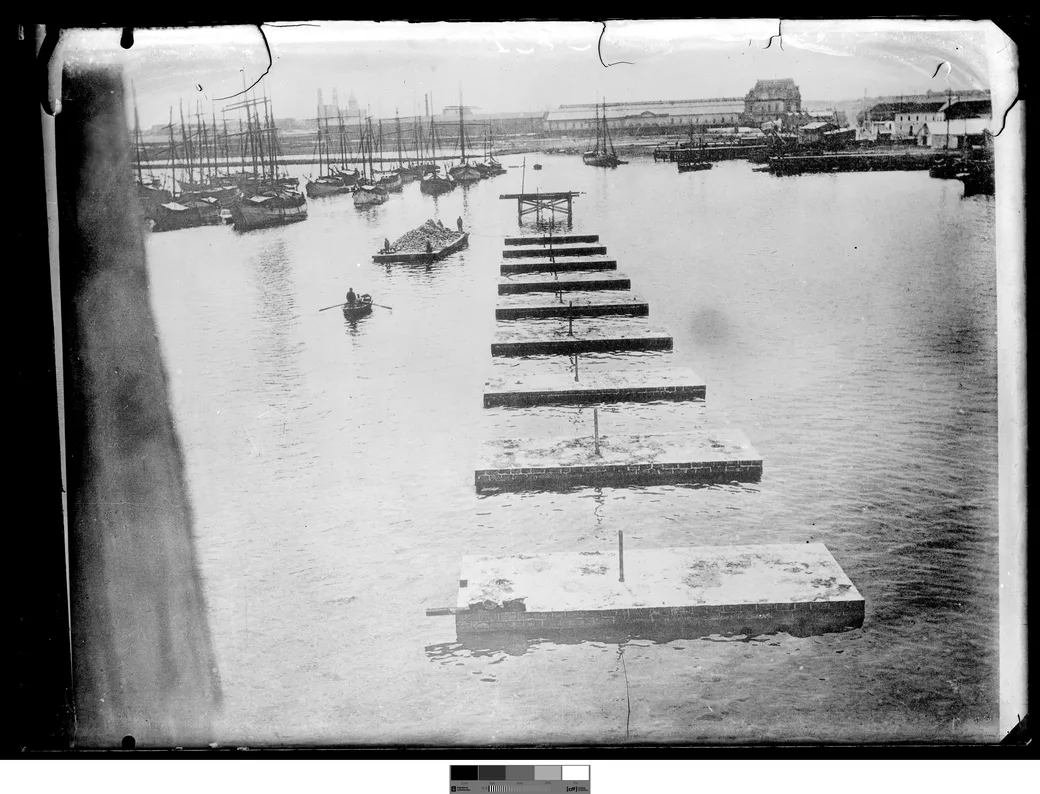
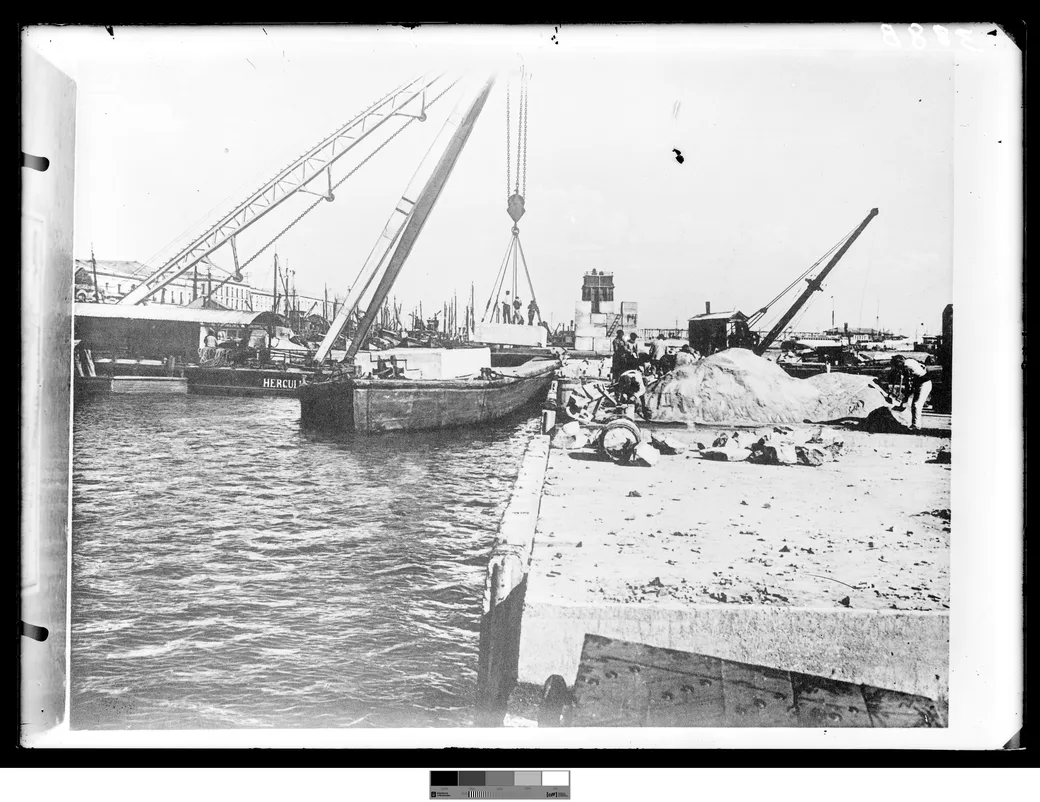
Port-building, method visible. What the plates preserve best is technique. In one, concrete caissons ride the water in a queue, each waiting its turn to be sunk as a section of the river wall of dársena 2 — one of the port's enclosed basins. In another, the crane does the day's real arithmetic: dressed stone out of the barge, block by block, onto the growing quay. A third watches the Sarandí breakwater stretch across the bay while the Hotel Nacional and the old town hold the horizon. The account books closed on 30 November 1909 at nearly seventy-one million francs — a little over thirteen million pesos of the era — for the dredging, the two breakwaters, the girdle dike and the twin piers with their river walls.
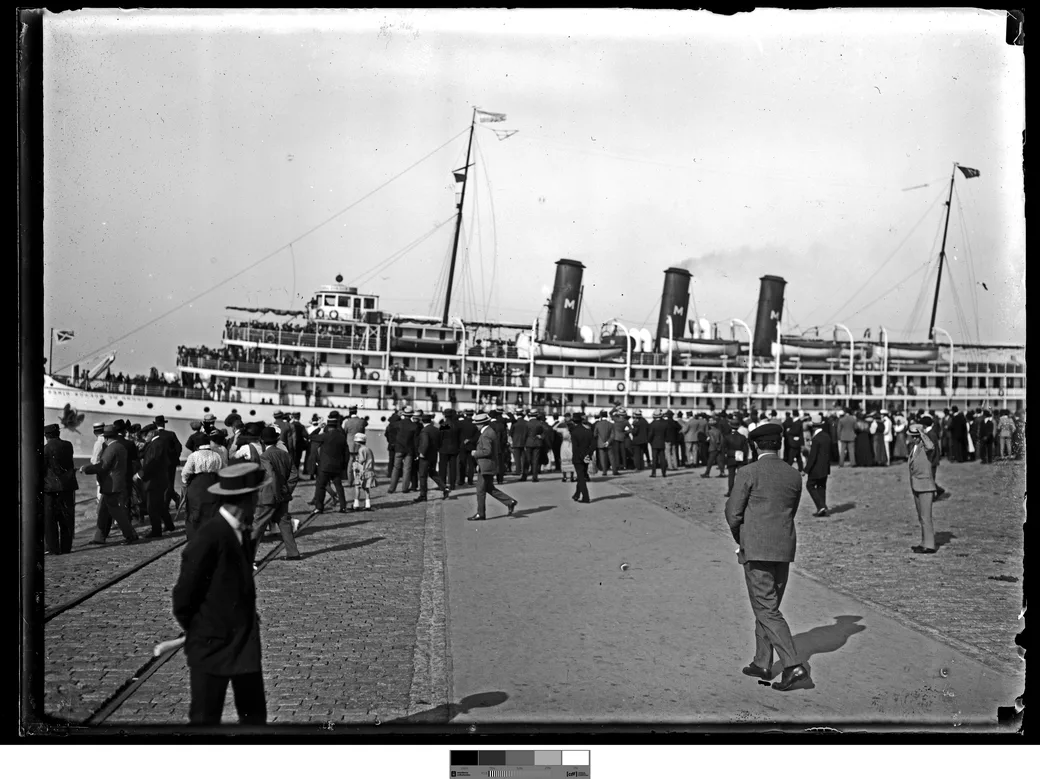
What the port carried. Finishing took longer than inaugurating — a supplementary contract approved in May 1909 kept the west breakwater growing and the dredges working into 1911 — but the purpose arrived on schedule. By 1916 the harbour had its governing body — the ANP, founded that year and running the port still — and its proof of concept: an ocean liner, three funnels tall, resting at Dársena I while a well-dressed crowd takes the quay like a plaza. Everything the city did next needed this gate: cargo landing, provisions moving inland, whole neighbourhoods filling in behind the waterfront. The bay made the city possible. The port made it go.
- "Historia del Puerto de Montevideo." Facultad de Ingeniería, UdelaR — the academic source for the entire construction chain: the law, the bidding, the contract, the ceremony, the cost table, the inauguration and the institutional aftermath. Read the document. Accessed Aug 14, 2026
- "100 años de la ANP." Centro de Fotografía de Montevideo (CdF) — corroborates the 18 July 1901 ceremony and the founding of the National Port Administration in 1916. Read the exhibition page. Accessed Aug 14, 2026
- "Puerto de Montevideo." Wikipedia (Spanish) — independently confirms the 25 August 1909 inauguration date. Read the article. Accessed Aug 14, 2026
- "Nuevo Puerto de Montevideo: 1909 - 25 de agosto - 2009." Crónicas Migrantes (blog) — a second independent corroboration of the inauguration date. Read the article. Accessed Aug 14, 2026
- "Historia del puerto de Montevideo (1500-1916)." independent history blog — general overview of the works; the sole source found for a disputed 1910 date, which is not adopted in this piece. Read the article. Accessed Aug 14, 2026
- "Dique Mauá." Wikipedia (Spanish) — confirms the 1872 dry dock, a private precursor unrelated to the national port project. Read the article. Accessed Aug 14, 2026
- Luque Azcona, Emilio. "Evolución urbana de Montevideo en el siglo XVIII." Asociación Española de Americanistas — backs Zabala's 1724 landing and the displacement of the Portuguese from the bay. Read the document. Accessed Aug 14, 2026
- "Montevideo, a 300 años del proceso fundacional." Museo Histórico Cabildo — general corroboration of the 1724 founding. Read the exhibition page. Accessed Aug 14, 2026
All five photographs are public-domain (CC0) records from the Centro de Fotografía de Montevideo (CdF), Fondo Municipal Histórico.