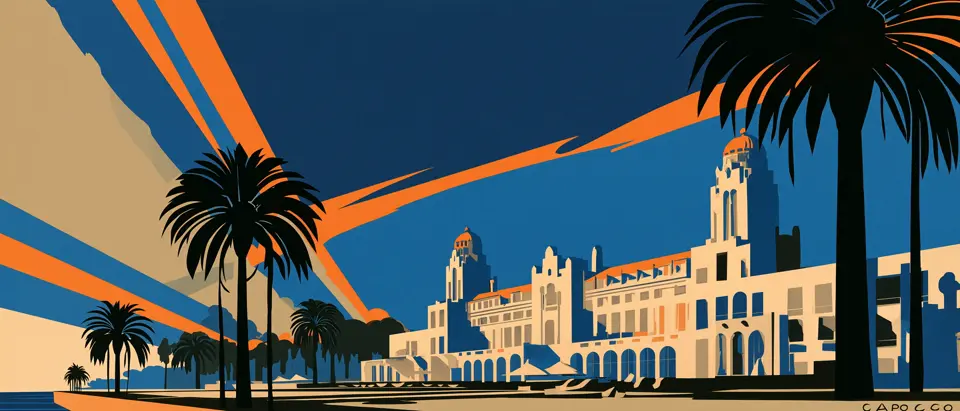
A grand hotel in the dunes
Seen from the air in 1936, Carrasco gives its secret away: the streets curve where the rest of Montevideo runs square, and they all bend around one building. The neighbourhood was drawn on paper before it existed — hotel first, city later. Much later.
Start with the aerial. In 1936 a camera looked down on Carrasco and caught what no street view can: an elliptical plaza with a grand hotel at its hub, tree-lined avenues radiating outward, and a young neighbourhood obediently filling in the pattern around them. Nothing about it is accidental — the curves were designed to break with Montevideo's colonial grid, and the building at the centre came first, on purpose.
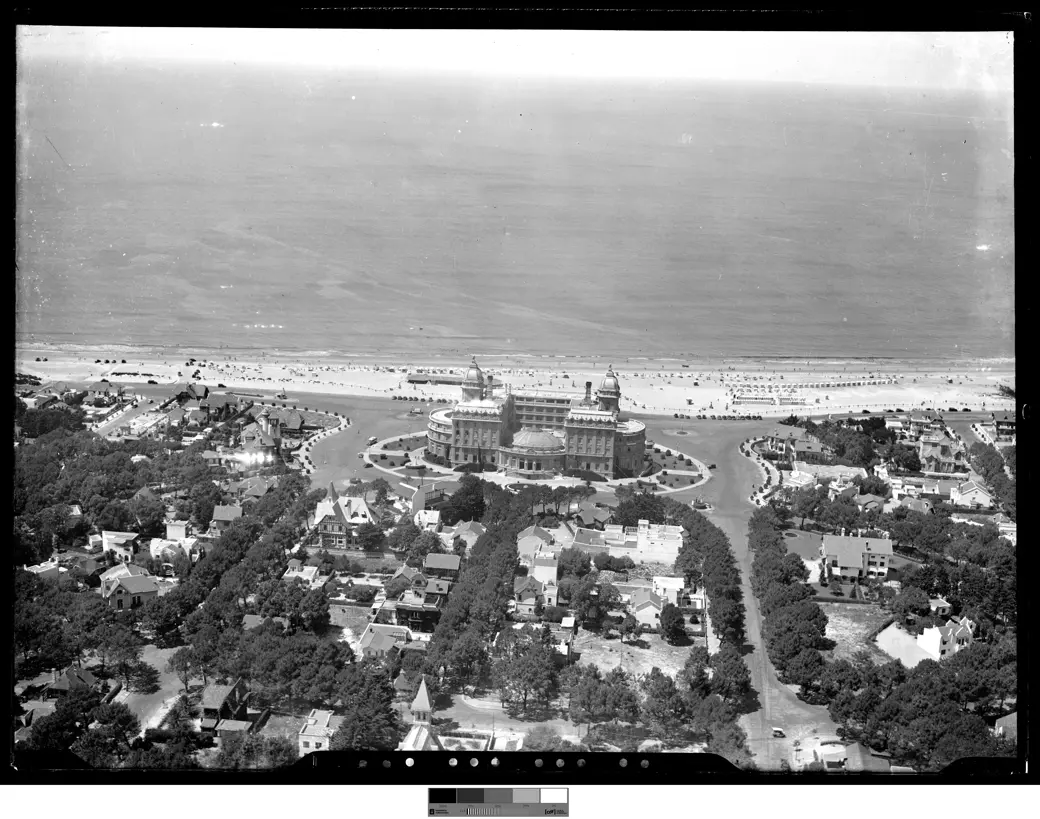
Paper before place. In the early 1900s three partners — Alfredo Arocena, Esteban Elena and José Ordeig — founded the Sociedad del Balneario Carrasco; the neighbourhood chronicle traces Arocena's ambition to Ostend, the Belgian seaside resort. The Society hired Charles Thays, the French landscape architect who had shaped Buenos Aires' parks, to draw their seaside town. His plan won approval in May 1912: curved streets through the dunes and a place of honour reserved for a grand hotel with its own staircase down to the sea. The municipal record's later summary of the site is hard to improve on — "a desert of sand, far from the city, nothing around but dunes."
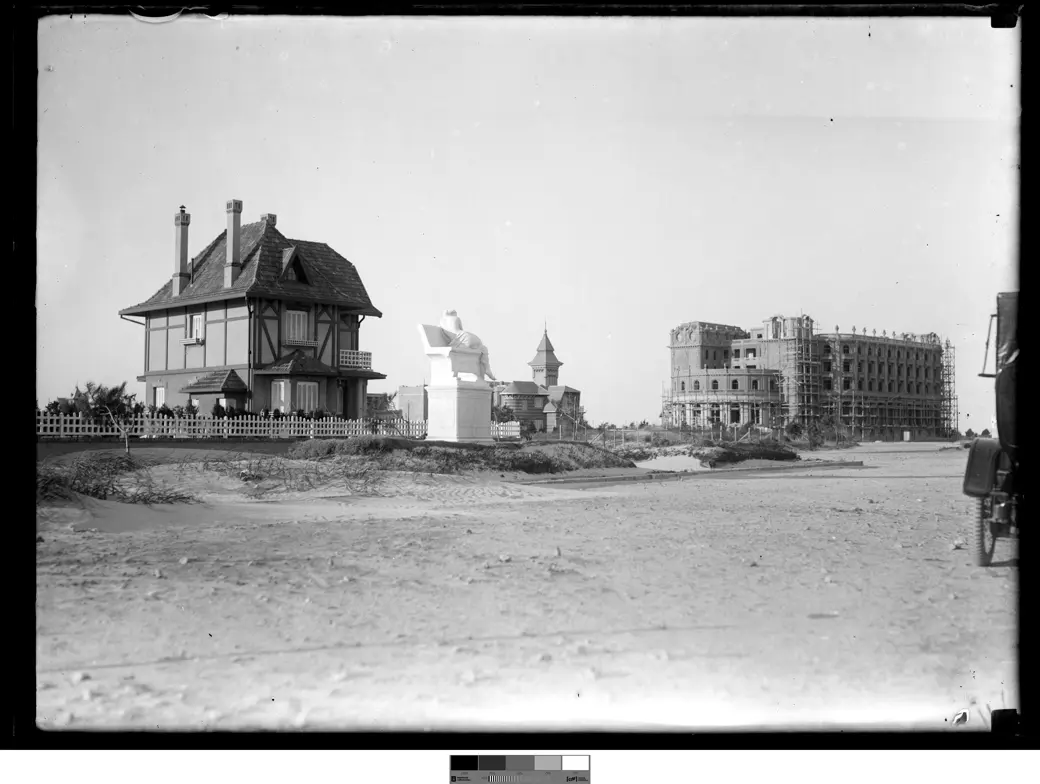
The money ran out halfway. A decree of 31 May 1912 authorized the works — with a reversion clause handing the hotel to the city after thirty-five years, though events would move far faster than the paperwork imagined. The Society staged an international competition (ten entries; the Swiss pair Dunant and Mallet won; their design proved unaffordable) and handed execution to Félix Elena, brother of one of the founders. By January 1914, with the walls part-raised, the private venture was broke. What saved the building was its future owner arriving early: around 1915 the Intendencia under Santiago Rivas bought land and works for up to 250,000 Uruguayan pesos of the day — covering only what had been spent — and brought in the architects Sambucetti and Baldomir, who delivered the structure in 1918 or 1919 (the record keeps both years). Interiors and furnishing filled the last two years, directed by the municipal architect Eugenio Baroffio.
A gala with no neighbours. A "Gran Diner Concert" opened the doors on 29 January 1921, the official inauguration following on 4 February. The year's plate undercuts the gala perfectly: a finished palace, one empty rambla corner, a single bench — and no other building in sight.
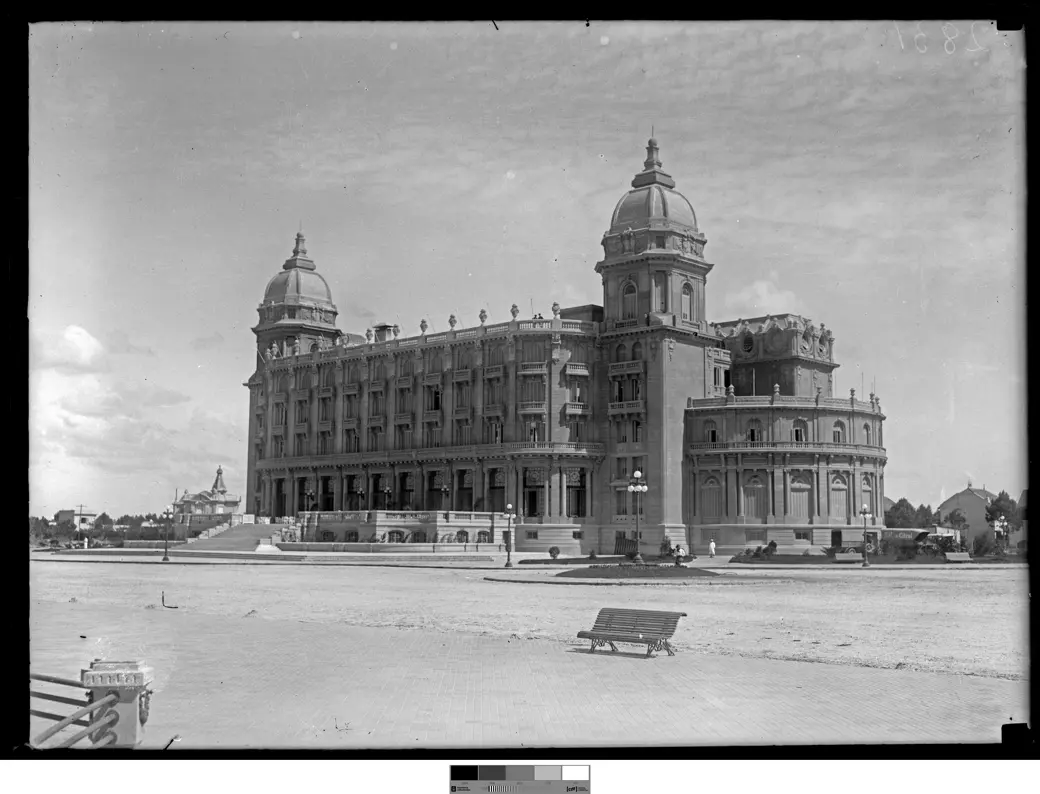
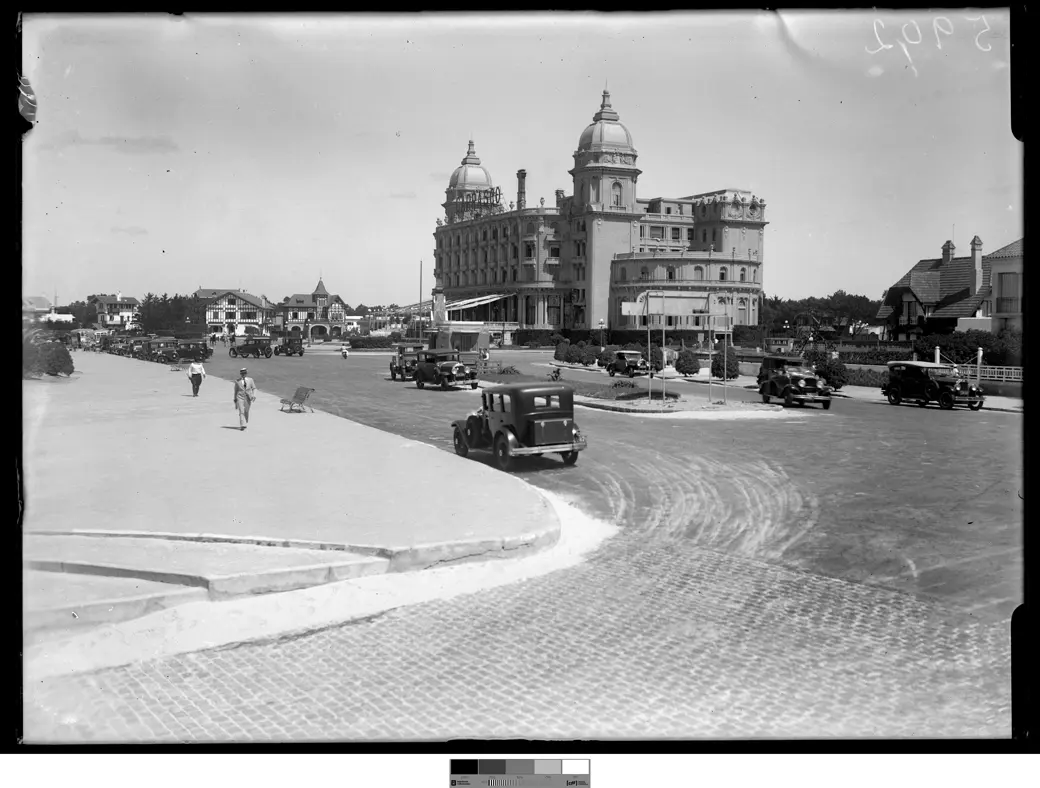
Two ramblas, two scales. The number that matters is 1952: only then did Montevideo's coastal corridor, built out in stages from Pocitos, run unbroken all the way to the Arroyo Carrasco — thirty-one years after the opening dinner. Carrasco itself was never roadless; the Rambla República de México, drawn into the resort's own plan, ran past the beach from 1917, and the 1933 plate shows it paved and parked with automobiles. The distinction is scale. The hotel had a street from the start. What it waited three decades for was the city.
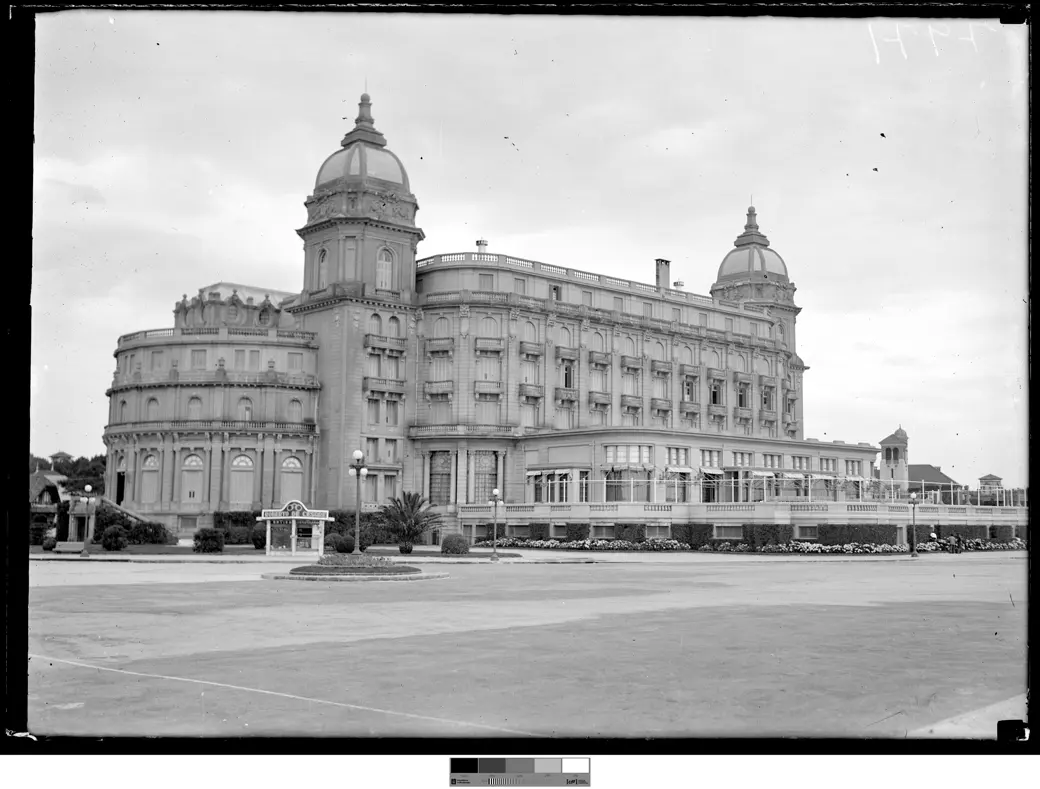
Institution. By 1943 the plate shows mature hedges and formal gardens — a frontier outpost turned fixture. National Historic Monument in 1975; closed in 1997; reopened, after years of back and forth, as a Sofitel in 2013. Go back to the 1936 aerial and the whole story is already there: one building holding the centre of the drawing, and a city still filling in the lines.
- "Un hotel con historia." Intendencia de Montevideo — official historical summary, based on Prof. Daniela Tomeo's 2010 research, covering the hotel's construction, financial crisis, municipal purchase and expansions. Read the document. Accessed Aug 13, 2026
- "Historia de los barrios: Carrasco." AMEC — the Sociedad del Balneario Carrasco, Arocena, Elena and Ordeig, and the commission of the plan to Charles Thays. Read the article. Accessed Aug 13, 2026
- "Centenario del Hotel Carrasco." Sociedad de Arquitectos del Uruguay — corroborates the 29 January 1921 opening with its "gran dinner concert." Read the article. Accessed Aug 13, 2026
- "Hotel Carrasco." Municipio E, Intendencia de Montevideo — the hotel's address on Rambla República de México and its 1915 municipal purchase. Read the article. Accessed Aug 13, 2026
- "Hotel Carrasco." Wikipedia — the exact date of the Sofitel reopening, 7 March 2013. Read the article. Accessed Aug 13, 2026
All five photographs are public-domain (CC0) records from the Centro de Fotografía de Montevideo (CdF), Fondo Municipal Histórico.