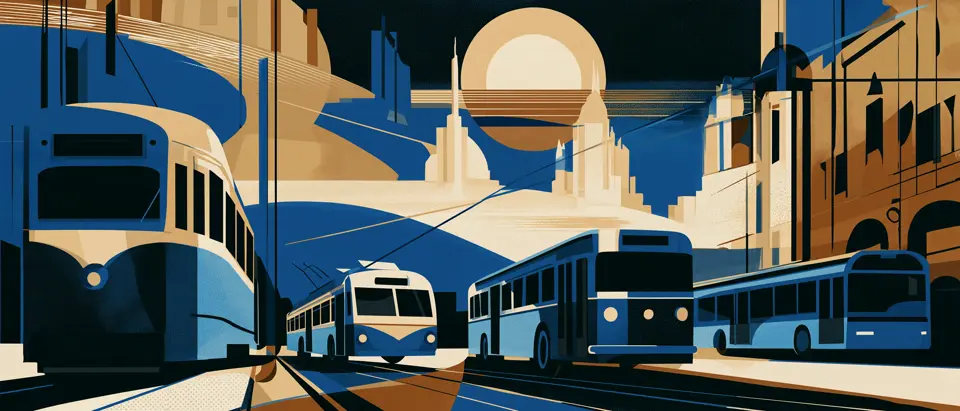
Tram, trolleybus, bus: the succession
On a January night in 1992, a farewell caravan brought Montevideo's last trolleybus into the Estación Buceo, more than forty years after the first one ran. The story behind it starts with a tram network and runs through two changes of vehicle, from tram to trolleybus to bus.
The end came as a procession. On the night of 26 January 1992, a farewell caravan closed Montevideo's trolleybus service, car number 44 pulling into the Estación Buceo for the last time, more than forty years after trolleybuses first ran in the city. Nothing had broken; the city government had decided to renew the fleet with buses. The open archive, which photographed the system's workshops so often in the fifties, holds no image of that goodbye. Some endings only survive in writing.
Where it started. The inheritance of AMDET, Montevideo's municipal transport agency, was a tram fleet whose cars were numbered up to 887, many of them out of service, along with two bus companies, AMSA and TUSA. The agency was created on 29 December 1947 under Law 10.980, which expropriated the tram concession, and began running the service in January 1948.
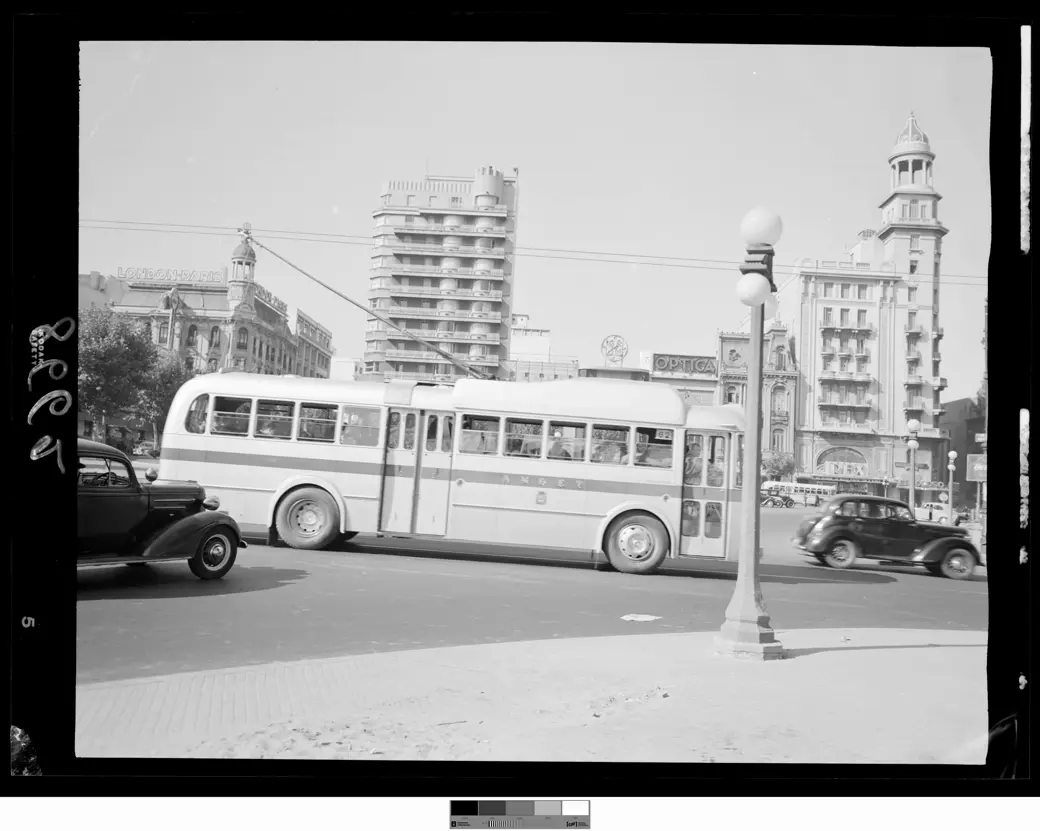
Trolleybuses from abroad. The first trolleybuses, British-built, reached the port on 11 February 1951, and in March line 62 began running on Calle Colonia. These were new vehicles bought abroad, not trams rebuilt. The plan behind them had been approved the previous December. The fleet reached 250 by 1955 and sixteen lines had opened by 1959, while the trams were retired route by route until the last of them stopped in 1956–57.
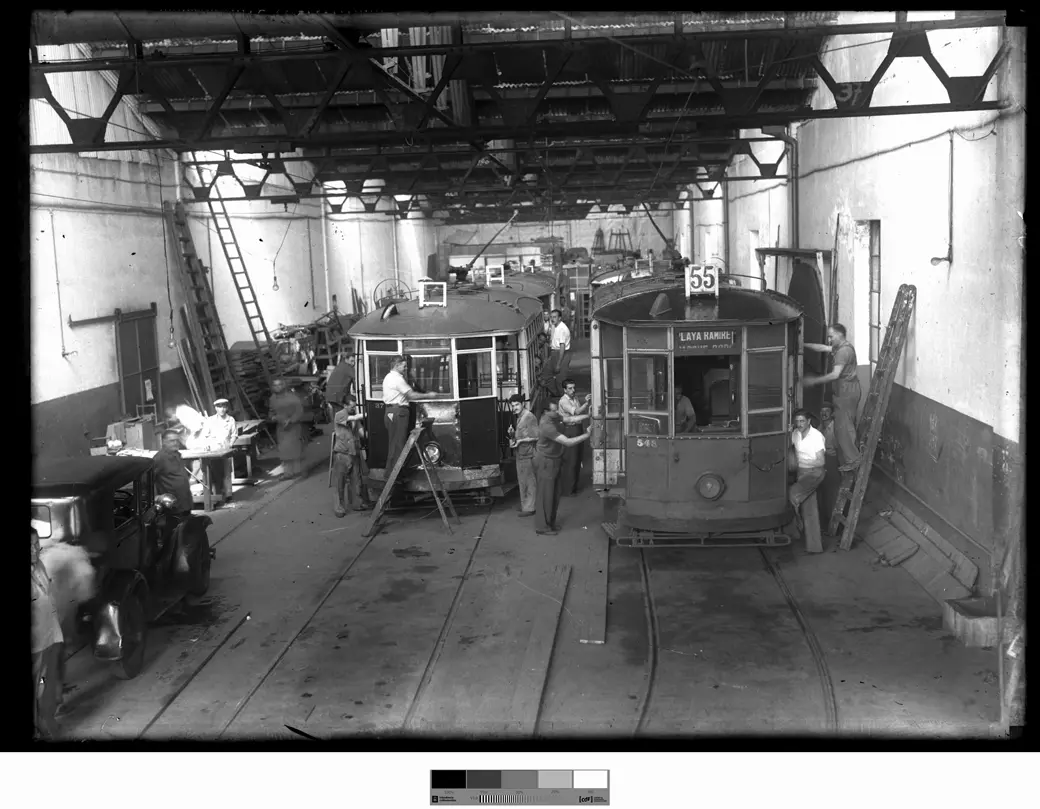
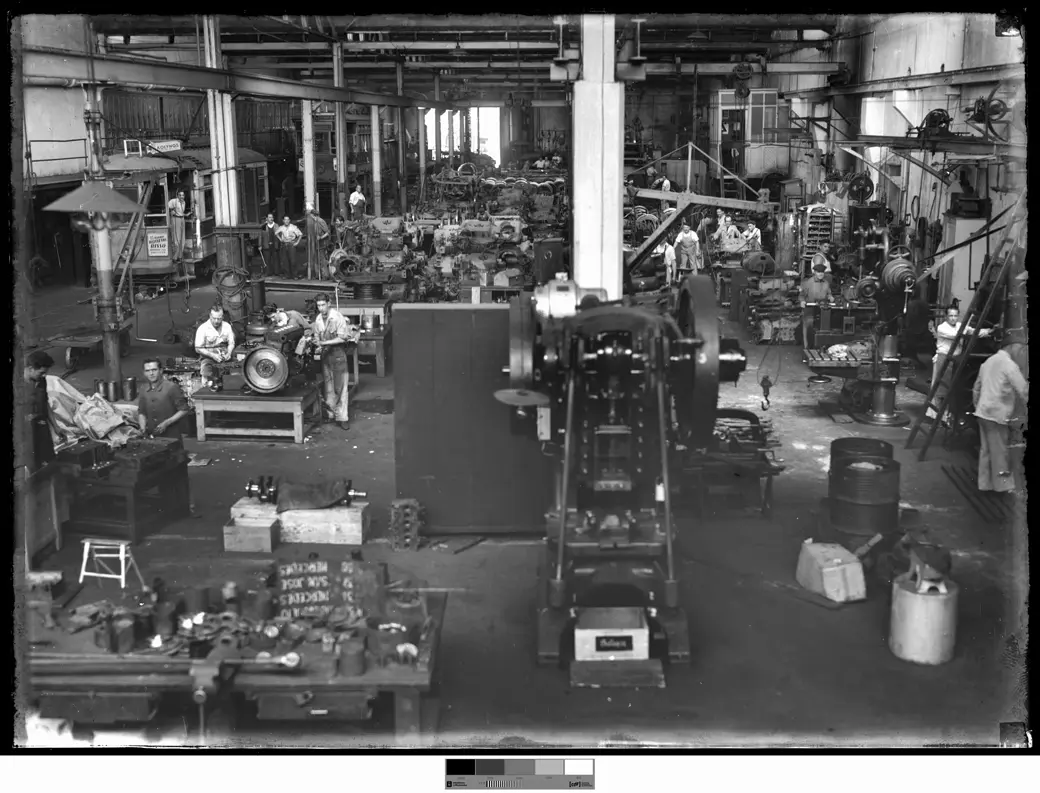
AMDET's workshops were photographed again and again through those years: tramcars standing among workers in a shop, a main floor of lathes and presses at factory scale, a body panel being shaped by hand at a bench. Keeping a fleet running while it changed, the photographs suggest, took a whole shop floor — machine tools and hands.
The dismantler, dismantled. AMDET's own turn came in the mid-seventies. The city spun the service out to its workers — three cooperatives, COTSUR, RAINCOOP and COOPTROL, took over the routes in 1975 — and on 1 February 1976 the agency itself was wound up, twenty-eight years after it was created. It had seen the tram off; it did not live to see the trolleybus go.
A tail that reaches 2016. The cooperatives outlived the trolleybus, though not all of them for long. COOPTROL wound down with the trolleybuses in 1992, and its 502 workers crossed to CUTCSA owning one-twelfth of the new buses. COTSUR stopped that same October. RAINCOOP, the last piece of what had been AMDET, stayed on the road until it closed in 2016 — almost a quarter century after the last trolleybus.
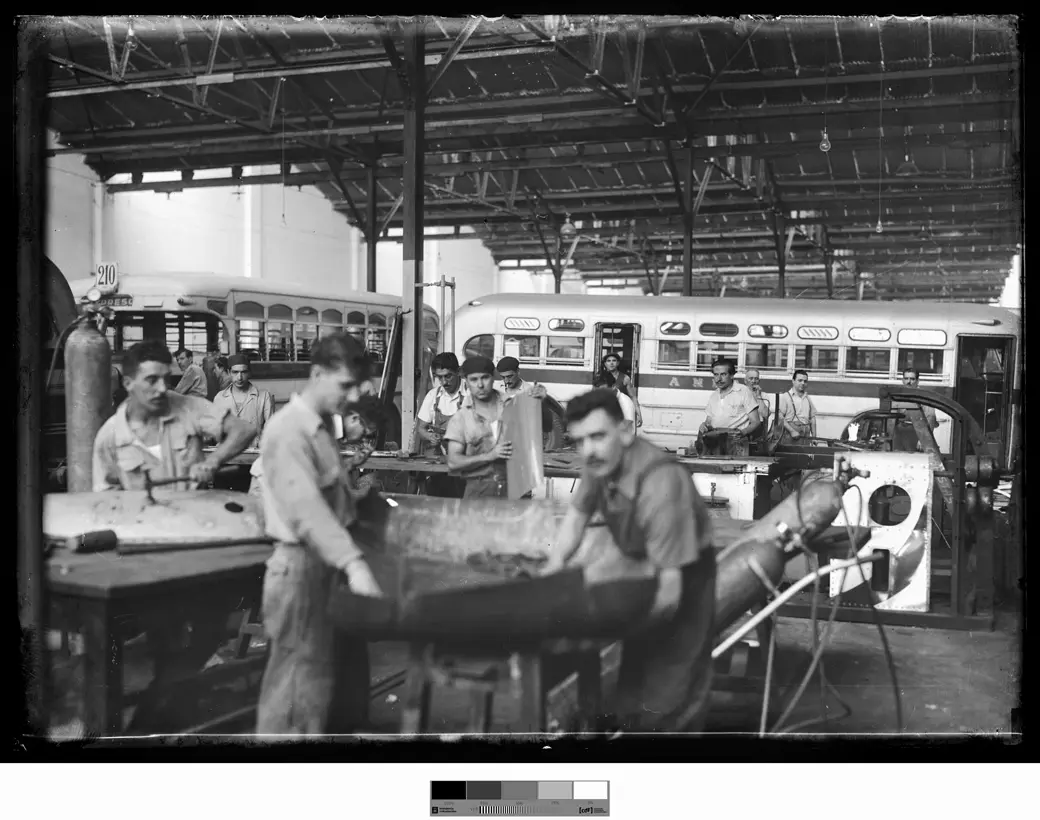
What remains. The buses won. What the archive keeps is the work behind the change: workshops the size of factories, panels worked by hand, and a municipal company that buried the tram and was itself wound up long before the trolleybus it had launched.
- «Cooperativas, Estado y Mercado. Privatización del transporte público de Montevideo a través de cooperativas.» Juan Pablo Martí, Faculty of Social Sciences (Universidad de la República) — AMDET's creation on 29 December 1947, the state of the inherited trams (many out of service), the 1950 trolleybus plan and its 1951 start, the three 1975 cooperatives, the end of the trolleybuses in 1992 and what became of COOPTROL, COTSUR and RAINCOOP. Read the paper (Spanish, PDF). Accessed 10 · OCT · 2026
- «Ley N.º 10.980, Empresas de transporte colectivo.» Parlamento del Uruguay, promulgated 6 December 1947 — the expropriation of the concession rights and assets of Montevideo's public-transport companies. Read the text of the law (Spanish). Accessed 10 · OCT · 2026
- «Administración Municipal de Transporte de Montevideo.» Wikipedia (Spanish) — the numbering of the inherited tramcars (No. 1 to No. 887), the start of operations in January 1948, the first trolleybuses landing at the port on 11 February 1951, the first trolleybus line (No. 62), 250 trolleybuses by 1955, and the agency's dissolution on 1 February 1976. Read the article (Spanish). Accessed 10 · OCT · 2026
- «COOPTROL.» Wikipedia (Spanish) — the farewell runs of 26 January 1992 and car no. 44 making its last entry into the Estación Buceo. Read the article (Spanish). Accessed 10 · OCT · 2026
- «Historia de los trolebuses de Montevideo» (parts one and two). The Age of the Train, an enthusiast site that is no longer online; Internet Archive copy of 20 July 2019 — the chronology of trolleybus lines opened between 1951 and 1959, the last on 16 September 1959 (the total of sixteen comes from counting the lines it lists), the first 18 British coaches and the 250 trolleybuses of 1955. Part one · part two (Spanish). Accessed 10 · OCT · 2026
- «Raincoop dejó de circular y no está en la calles desde hoy.» El Observador, 10 June 2016 — RAINCOOP stops running, the last of the cooperatives that came out of AMDET. Read the report (Spanish). Accessed 10 · OCT · 2026
- «Inauguración de la primera línea de Troleybús de Montevideo. Colonia entre Río Negro y Julio Herrera y Obes.» Centro de Fotografía de Montevideo (CdF), Fondo Municipal Histórico, inv. 08662FMHGE, 1951, public domain (CC0). View the catalogue record. Accessed 10 · OCT · 2026
- «Talleres de la Administración Municipal de Transporte de Montevideo (AMDET).» Centro de Fotografía de Montevideo (CdF), Fondo Municipal Histórico, inv. 26330FMHGE, 1950s, public domain (CC0). View the catalogue record. Accessed 10 · OCT · 2026
- «Talleres de la Administración Municipal de Transporte de Montevideo (AMDET).» Centro de Fotografía de Montevideo (CdF), Fondo Municipal Histórico, inv. 23701FMHGE, 1947–1956, public domain (CC0). View the catalogue record. Accessed 10 · OCT · 2026
- «Talleres de la Administración Municipal de Transporte de Montevideo.» Centro de Fotografía de Montevideo (CdF), Fondo Municipal Histórico, inv. 25237FMHGE, 1950s, public domain (CC0). View the catalogue record. Accessed 10 · OCT · 2026