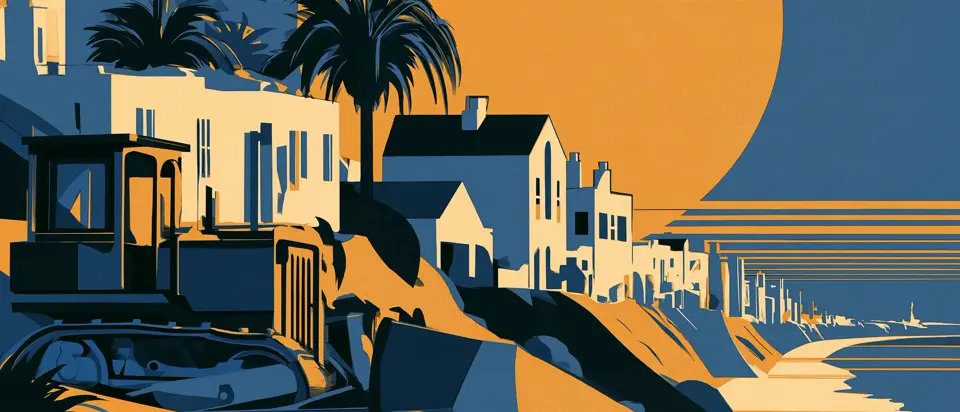
Barrio Sur's two evictions
Ride east along Montevideo's rambla from the old town and you pass Barrio Sur, the historic home of candombe. Its seafront was cleared of people twice: first a poor quarter called El Bajo, between 1923 and 1935, then, under the military dictatorship of 1973–1985, the Medio Mundo and Ansina tenements. This is what the record shows, and where to go to see it.
Start at the plaque. At Zelmar Michelini 1080, a few blocks inland in Montevideo's Barrio Sur, a memorial plaque marks where a tenement called Medio Mundo stood until December 1978. It can't be seen from the bike lane on the rambla, the city's long waterfront avenue, and that is part of the story. The shore you ride past here was reshaped twice by removing the people who lived on it. The two episodes are half a century apart, and they are different in kind.
The stretch you ride. The protected lane runs east from the Escollera Sarandí breakwater at the tip of the old town. Street maps call this seafront Rambla Gran Bretaña; from Andes street it becomes Rambla República Helénica, the segment that fronts Barrio Sur. A seawall, a wide promenade, a row of buildings turned away from the water: nothing on the lane says how it came to look like this.
1923–1935: El Bajo. Until the 1920s this coast came down to the water through El Bajo, a cramped quarter of shacks and port trade, bounded by Yerbal, Maldonado, the Recinto and the Brecha, which the city of the day regarded chiefly as its red-light district. In the 1920s the city decided to wall this shore against the sea and run a promenade along it, the Rambla Sur, and it framed the work partly as a clean-up. El Bajo stood in the way: the city expropriated the whole quarter and demolished it between 1923 and 1935. Urban historians describe the operation in terms of class and hygiene: poor residents were moved out to "peripheral areas" of the city, and the record does not say where. Víctor Soliño wrote the tango "Adiós mi barrio" about the loss; it was performed at the 1930 Carnival.
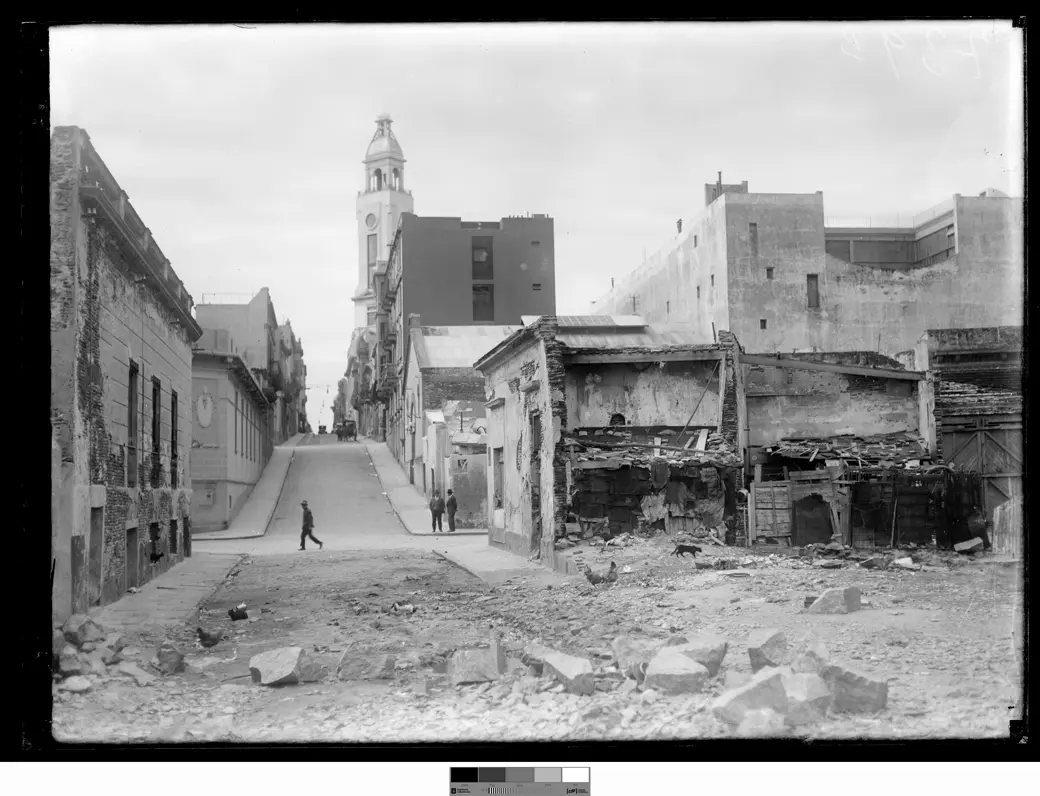
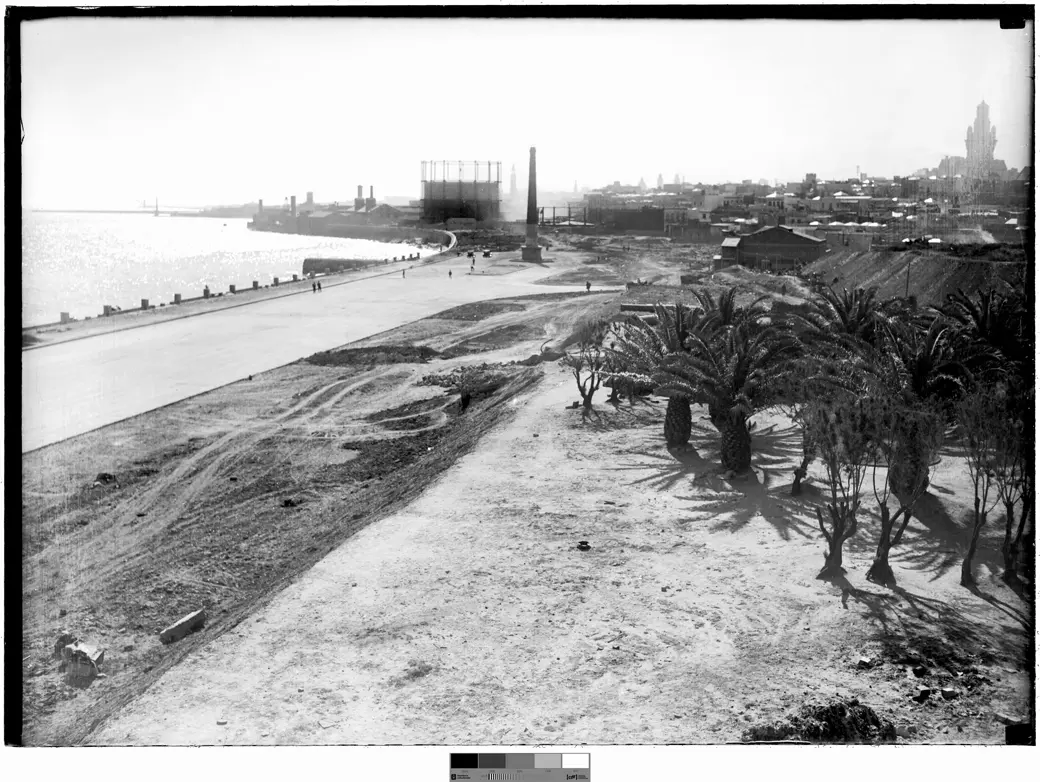
What the works left. Photographs of the building site show concrete advancing over the old shoreline, and the neighbourhood's cross streets, Cuareim among them, cut off by the new wall. Where there had been the Santa Ana and Patricios beaches and the houses of El Bajo, there was now the unbroken seafront that is ridden today. Note the name Cuareim: the second episode happens at number 1080.
Candombe's home ground. Candombe is the Afro-Uruguayan drumming and dance tradition, and Barrio Sur, with neighbouring Palermo to the east, is its historic heart. After Uruguay abolished slavery in 1842, a large Afro-Uruguayan community settled here, many of them in conventillos, the crowded collective tenements of the old city; by 1867 Barrio Sur alone had 115. Medio Mundo, at Cuareim 1080 between Durazno and Isla de Flores, opened in 1885 with forty rooms on two floors around a central patio. Candombe troupes known as comparsas came out of its patio, Miscelánea Negra and, later, Morenada among them; in 1954, on the occasion of a UNESCO conference in Montevideo, the painter Carlos Páez Vilaró organised a cultural event in the building. Medio Mundo's block runs up to the route of the Llamadas, candombe's street parades, which every February march along Isla de Flores between Zelmar Michelini, formerly Cuareim, and Minas.
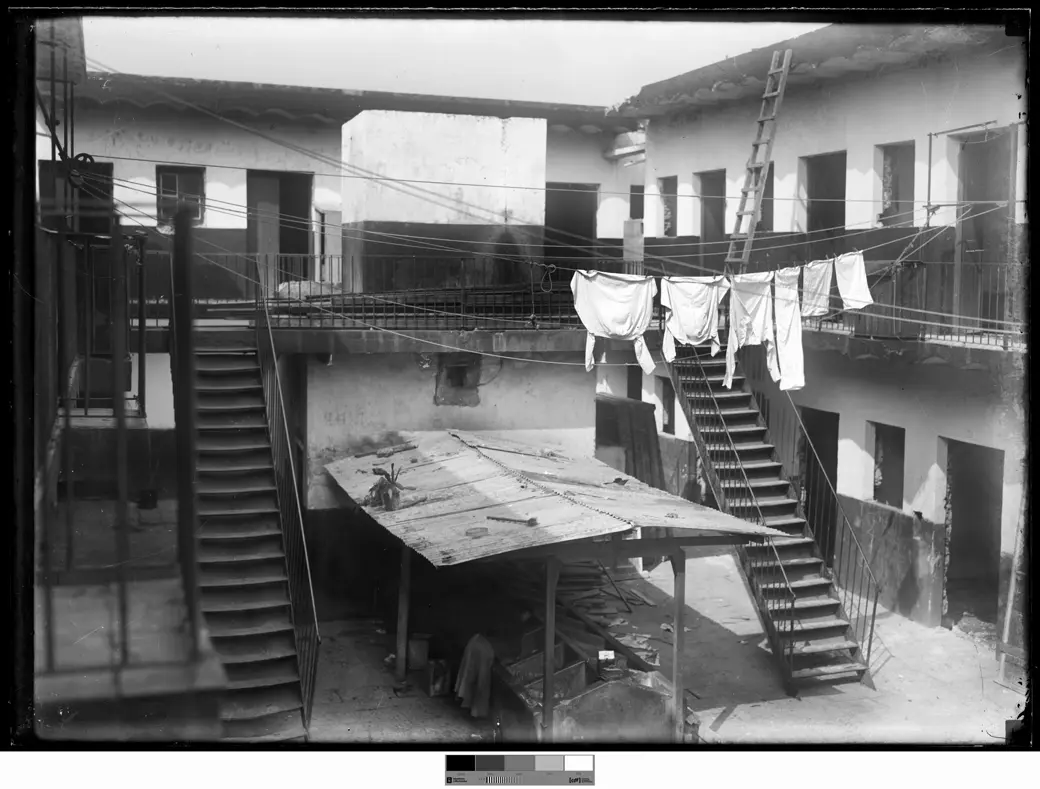
1978–1979: Medio Mundo and Ansina. Uruguay was then under a civic-military dictatorship (1973–1985). On 3 December 1978, Montevideo's city government ordered Medio Mundo's residents out, saying the building was in danger of collapse; no technical survey supported the order. The last llamada, the candombe drum call, was played in the patio that afternoon, and on 5 December the building was knocked down. Ansina, a tenement complex in the Reus al Sur area of Palermo, was emptied from 14 January 1979 on the same claim of ruin. Its buildings, though, were left to decay for almost three decades: what remained was demolished only in 2008, and cooperative housing now stands on the site. The move, residents had been told, was temporary, and better housing would follow. It did not; many were resettled on the city's outskirts, in Cerro Norte among other places. Scholars of the period, following the historian George Reid Andrews, call these evictions an act of racial violence against the Afro-Uruguayan community: a charge the documentary record does not make about El Bajo, whose clearance it describes only in terms of class.
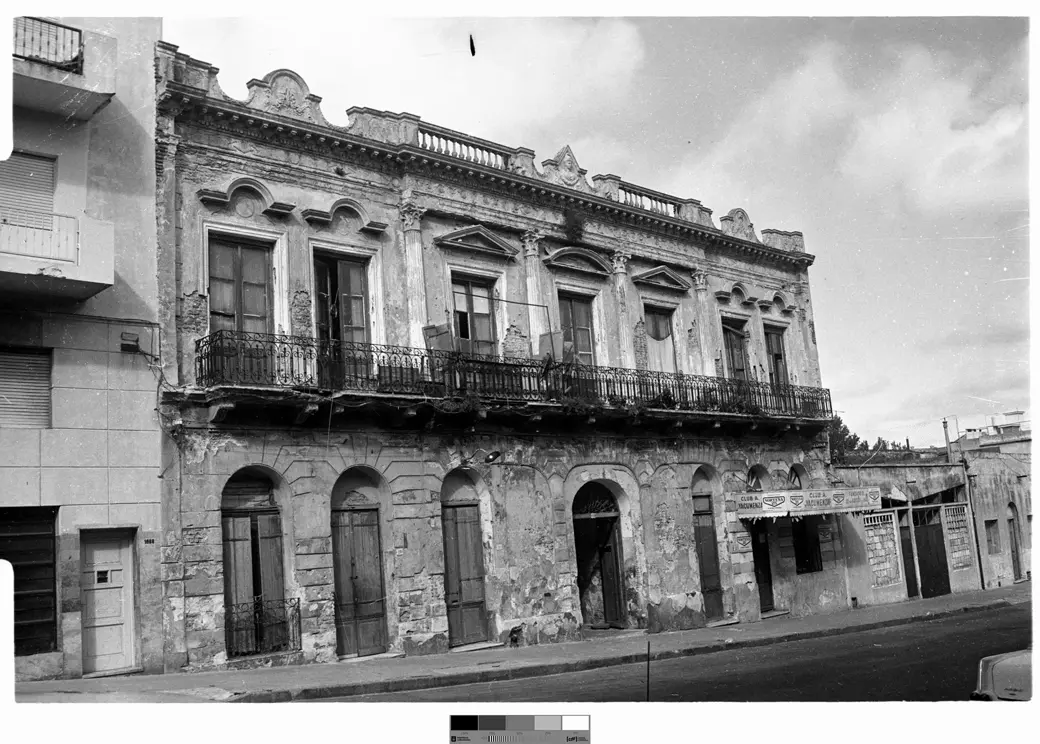
How it is remembered. Candombe outlived the building. A comparsa still performs under the name Cuareim 1080, the tenement's old address, and the drums come back out every year for the Llamadas. The state has since put what happened on record. National Candombe Day falls on 3 December, the date of that last llamada in Medio Mundo's patio; a 2006 law, No. 18.059, made it official. The national commission for sites of memory has put up two plaques: at Cuareim 1080 in 2019, for Medio Mundo's families, and on Ansina's own site in Reus al Sur in January 2020. Since 2008 the one-block Curuguaty pedestrian street, near the first plaque, has carried the name Peatonal del Candombe.
Getting there. From the rambla lane, turn inland at Plaza República Argentina or at Andes street. The plaque at Zelmar Michelini 1080 (the street was formerly Cuareim) is a few blocks north, in mixed traffic. Lock the bike there and walk the Peatonal Curuguaty, close by.
- Wikipedia ES, "Conventillo Mediomundo." Read the article. Accessed Sep 24, 2026
- INDDHH, "Colocación de placa Conventillo Medio Mundo." Read the article. Accessed Sep 24, 2026
- Intendencia de Montevideo / Municipio B, "Memoria y reparación en Reus al Sur Ansina." Read the article. Accessed Sep 24, 2026
- INDDHH, "Se colocó una Placa de Memoria en el Barrio Ansina." Read the article. Accessed Sep 24, 2026
- Contratapa, "La rambla de Montevideo, un fenómeno del siglo XX que mantiene su encanto." Read the article. Accessed Sep 24, 2026
- Centro de Fotografía de Montevideo (CdF), exhibition "Rambla Sur 1923-1935." Read about the exhibition. Accessed Sep 24, 2026
- M. Giacosa, "Transformaciones del paisaje urbano en Barrio Sur" (CFE thesis). Read the article (PDF). Accessed Sep 24, 2026
- Fontoura & Travieso (2020), "Rastros de modernidade: os aterros na memória urbana" (UPC Commons). Read the article (PDF). Accessed Sep 24, 2026
- Julia Yolanda Boronat, Revista Dossier, "Barrio Sur y Palermo: rivales y hermanos." Read the article. Accessed Sep 24, 2026
- Intendencia de Montevideo, "Peatonal del Candombe" (mapeo afrodescendencia resiliente). Read the article. Accessed Sep 24, 2026
The four photographs are public-domain (CC0) records from the Centro de Fotografía de Montevideo (CdF), Fondo Municipal Histórico.