
The ferry from Tigre: Carmelo and Uruguay's quiet west
Skip the fast crossing to Colonia. Take the three-hour delta boat from Tigre instead, step off at Carmelo — the only town Artigas founded that's still standing — and ride the west at its own unhurried pace, the bike aboard the whole way.
The boat leaves from Tigre, on the northern edge of Buenos Aires, and it is in no hurry. For about three hours it threads the Paraná delta — a labyrinth of brown channels, willows and houses up on stilts — before the maze finally loosens into the open Río de la Plata and sets you down at Carmelo, on the Arroyo de las Vacas. It's the crossing almost no one takes: most travellers do the wide, fast middle of the river, Buenos Aires to Colonia in an hour and a quarter. Come the slow way instead and the journey has begun before the bike is even ashore.
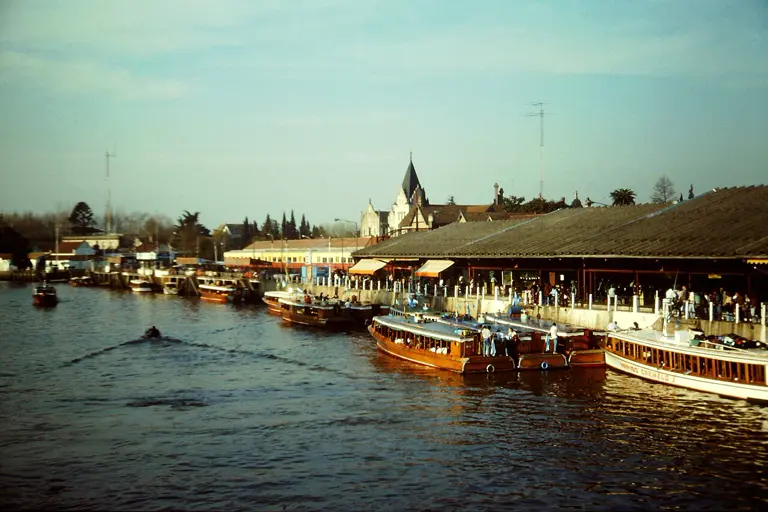
Where the crossing begins: the river terminal at Tigre, just north of Buenos Aires, boarding point for the delta boat to Carmelo. Photo bullit · CC BY 3.0 · Wikimedia Commons
Carmelo rewards the detour. It's a town of about twenty thousand that keeps the pace of a long afternoon, and it carries its history lightly: José Artigas founded it in 1816, and it's the only one of his foundations still standing. Life here collects along the Rambla de los Constituyentes, out on the water, where the sunset is the day's main event.
What you come to see still turns by hand. Carmelo's swing bridge — eighty-eight metres of German iron, forged by the combined works of Augsburg and Nuremberg — opened on 1 May 1912 and was never motorised: a crank, an operator, and the Arroyo de las Vacas swinging open beneath it. It's the only bridge of its kind in Uruguay, and by most accounts the first swing bridge built in South America. It dates from the early Batllista years, when the young country was working to loosen its commercial grip on Buenos Aires — and a century on it still opens for the boats, as slowly as everything else here.
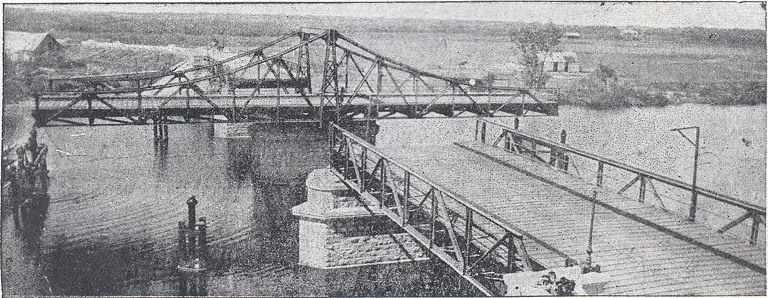
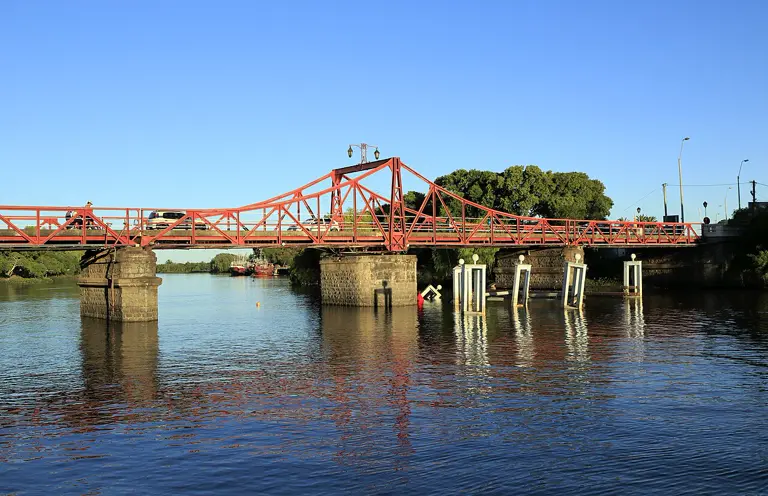
Left: opening day, 1 May 1912 — the swing bridge brand new. Photo Revista La Semana, 1912 · Public domain. Right: a century on, still on the job over the Arroyo de las Vacas. Photo Falk2 · CC BY-SA 4.0 · Wikimedia Commons
The other reason people come is what's in the glass. Since 1993 Carmelo has carried an INAVI-recognised Geographic Wine Indication — the country's oldest wine-region designation of its kind — and seven bodegas — wineries — sit within a sixteen-kilometre radius, most within easy pedalling of town. El Legado is almost on the plaza; Almacén de la Capilla, three kilometres out, takes walk-ins; Narbona, the oldest at 1909, sits fourteen kilometres off along Route 21 — a ride in itself rather than a casual stop. Tannat is the grape that defines the region, and the one you'll be poured first.
Pushing on toward Colonia is where the west asks for some planning. Route 21 is well paved, but it's part of a busy concessioned corridor — the Routes 21-and-24 axis carries around twenty-five thousand vehicles a day — and it's no place to spend hours on a bike. Riders who know the area thread the interior instead, along the parallel conchilla lanes: dead-straight dirt roads through vineyards and open country that hand the silence back, with the one caveat that a day's rain turns them to mud. That way runs past Conchillas, an old mining village with an incongruously English air, and over the low hills that fall toward the river. And at the close of the day, water again — the sun going down over the Plata from the beach, which in Carmelo is how everything ends.

The Arroyo de las Vacas at dusk — the tidal creek that makes Carmelo's port, and gives the town its river-mouth feel. Photo Tailandoni · CC BY-SA 4.0 · Wikimedia Commons
The practical box — the crossing and the west, at a glance
The ferry from Tigre. The Tigre–Carmelo river service is run by Líneas Delta Argentino (not Cacciola, which folded in 2019). It leaves Tigre for Carmelo on Wednesdays, Fridays, Saturdays and Sundays at 08:30, and returns on Mondays, Wednesdays and Fridays at 15:00 and on Sundays at 17:30; the crossing through the Paraná delta takes about three hours. Two things are worth confirming when you book, because neither is fixed: the fare (in Argentine pesos, and it changes often) and the bicycle policy, which the operator doesn't publish — its rules cover general luggage only. Don't assume they'll take the bike; ask before you buy the ticket, and count on it riding in the open, since the boat has no cargo hold. The current timetable and the country's other river crossings are in our getting-here guide.
Getting here from Montevideo. Carmelo is a few hours from Montevideo by road, with direct buses from the Tres Cruces terminal (confirm the bike policy with the company, as everywhere in the country).
The wine loop. El Legado and Almacén de la Capilla are the easiest stops by bike from the centre; Narbona, fourteen kilometres out, is better as a day ride. Most require a reservation — call ahead. Bikes can be rented in town.
On to Colonia. About 77 km by the direct road; the two-day loop through the interior adds a good deal more. Avoid Route 21 for the long stretches: the traffic is heavy and the shoulder isn't made for bikes. The conchilla lanes are prettier and safer — but they turn to mud in the rain.
- pedaleando-uruguay.bike — getting here by ferry (Líneas Delta Argentino schedule and bike policy).Read 14 · JUL · 2026
- MTOP (gub.uy) — Carmelo–Tigre river transport.Read 25 · JUN · 2026
- La Nación — Tigre–Carmelo by river (2022 relaunch, "no hold").Read 25 · JUN · 2026
- la diaria — 110 years of the Carmelo swing bridge (1912 opening, MAN, Batllista context).Read 25 · JUN · 2026
- Wikipedia — Puente de Carmelo (88 m; first swing bridge in South America; only one of its kind) and Carmelo (founded 1816, Artigas, population).Read 25 · JUN · 2026
- Enoturismo Carmelo — wine route (7 bodegas, Tannat, distances).Read 25 · JUN · 2026
- Montevideo.com.uy — Carmelo's wine geographic indication (INAVI-recognised IGV since 1993; the country's oldest).Read 14 · JUL · 2026
- El Observador — Carmelo's swing bridge anniversary (first swing bridge in South America).Read 14 · JUL · 2026
- Sacyr Concesiones — Routes 21 & 24 corridor (combined corridor ~25,000 vehicles/day).Read 25 · JUN · 2026