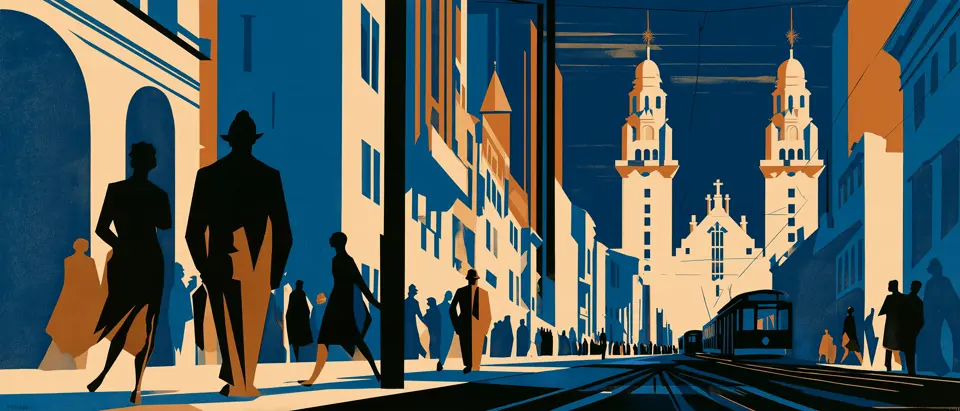
Sarandí before the pedestrian street
Ciudad Vieja's signature pedestrian walk took eighteen years to build — in four stages, against the objections of its own shopkeepers, who then asked for more. The archive kept the "before": a century of trams, shop windows and bumper-to-bumper traffic along the blocks where no car enters today.
Eighteen years. That's how long it took to turn the heart of Sarandí — Ciudad Vieja's narrow spine — from ordinary traffic street into the pedestrian walk every visitor now assumes was always there. The number matters, because nothing about today's peatonal was natural or inevitable, and the municipal archive holds the proof in both directions: photographs of the traffic century, and the paper trail of the fight that ended it.
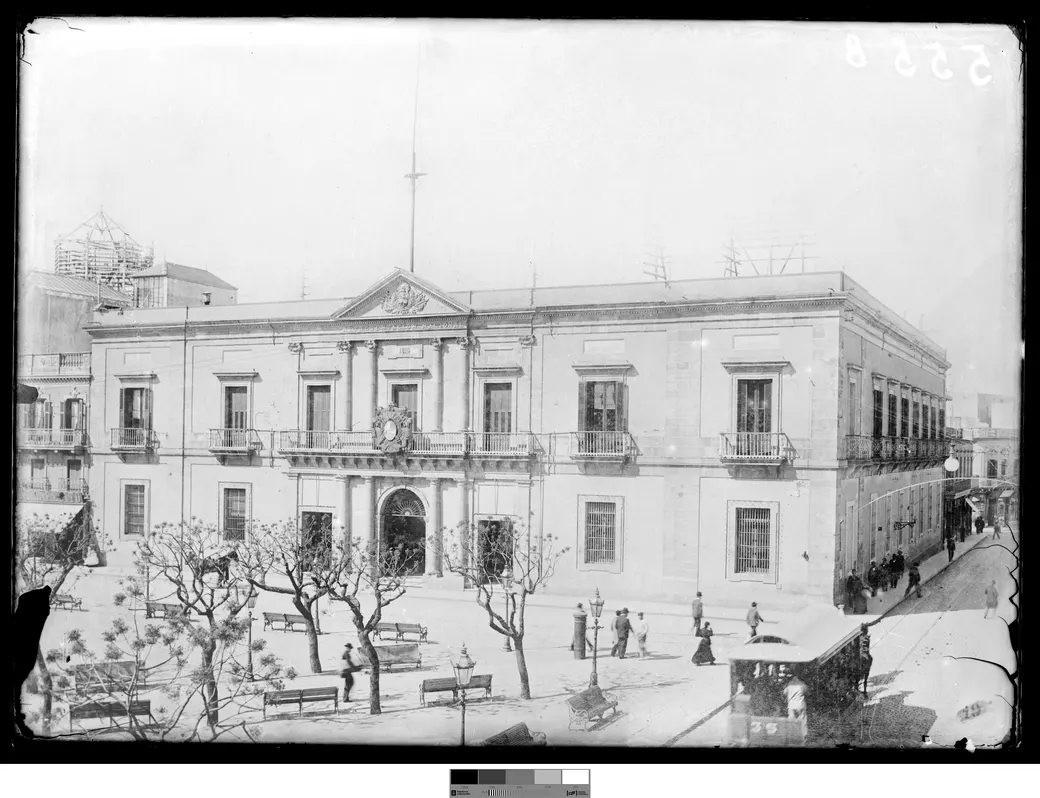
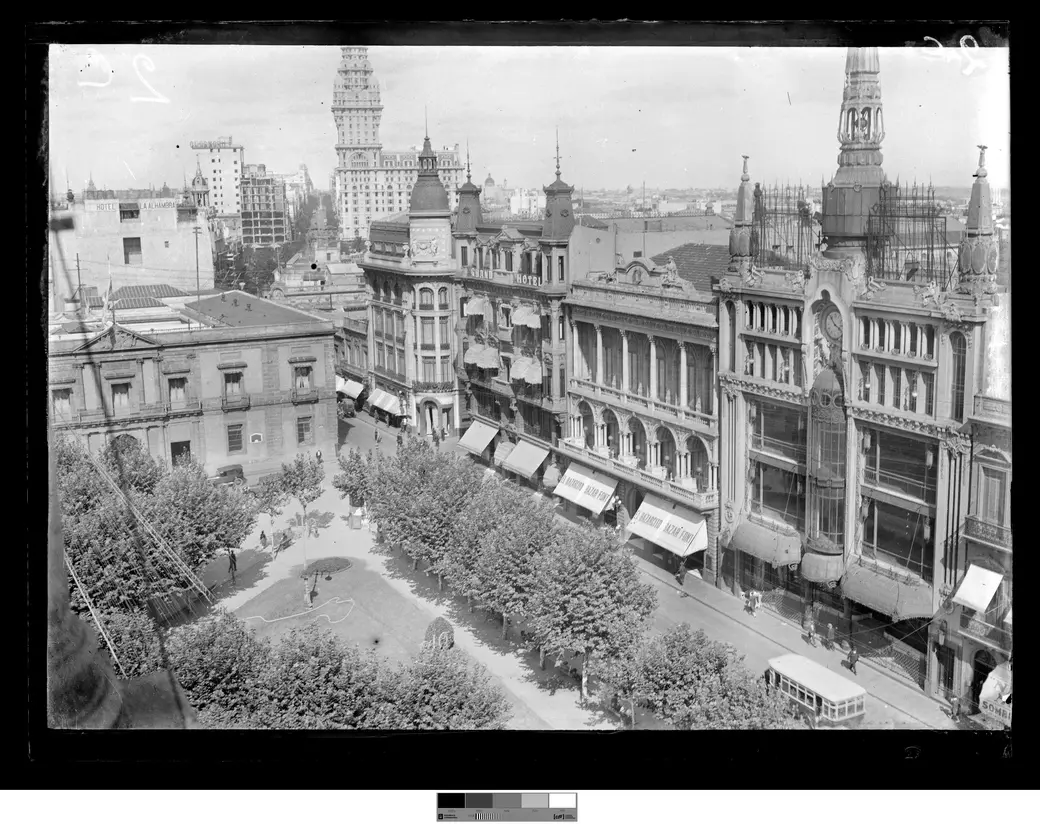
A street like any other — only narrower. Start the album in 1895, at the Juan Carlos Gómez corner facing the Cabildo: horses, tram equipment, the plaza doubling as a working yard. Return to the same corner around 1928 and the frame has filled in with named commerce — Grand Hotel Lanata, Club Uruguay, the Corralejo store. Sarandí had become the old city's shop window, and everything on wheels squeezed through it.
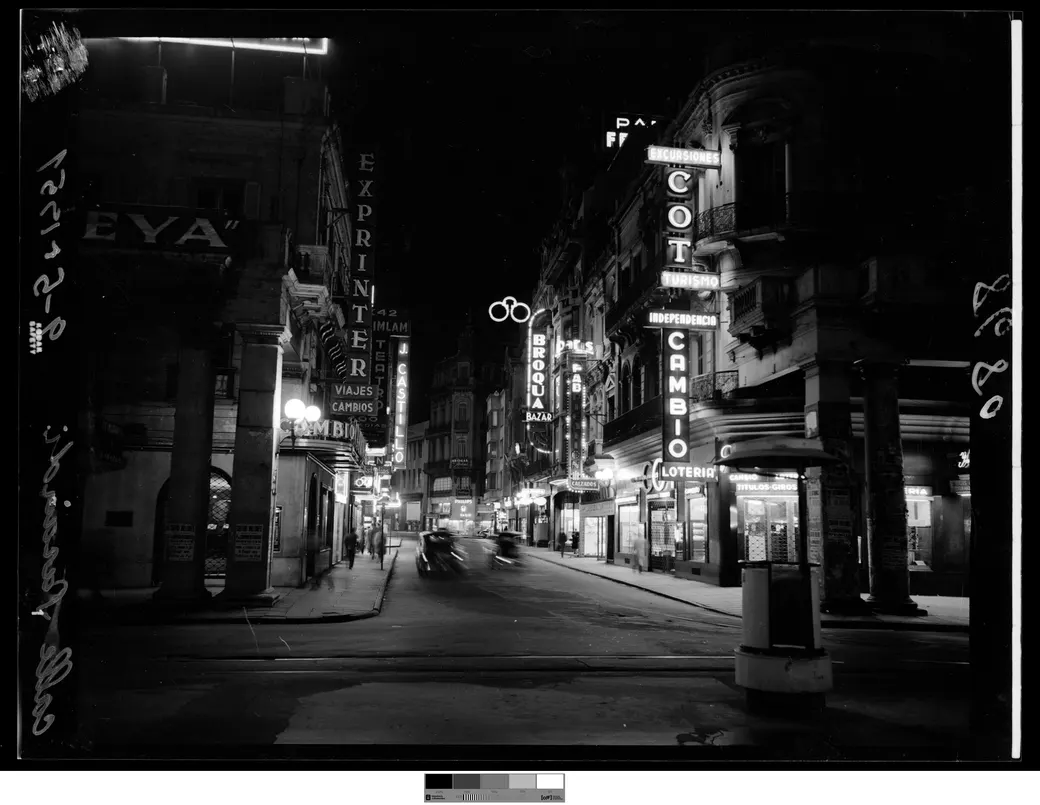
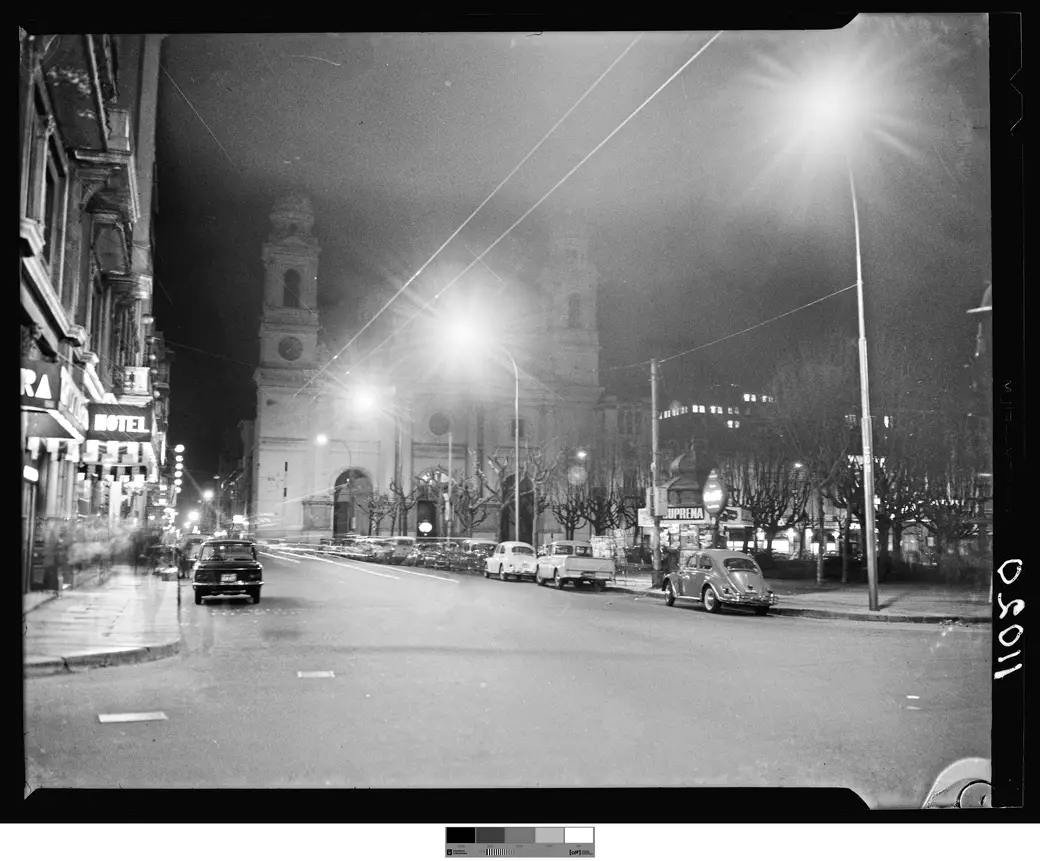
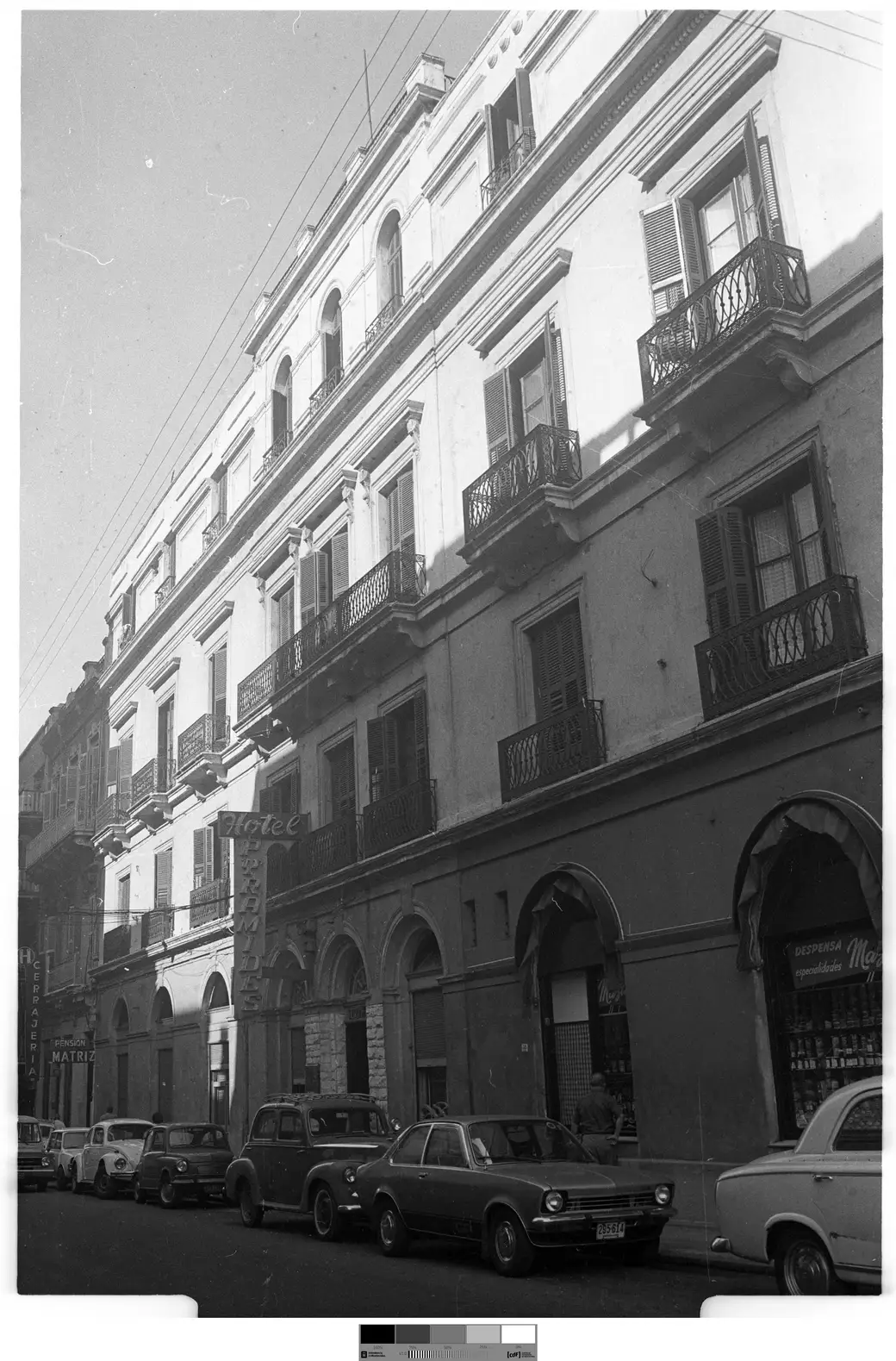
Then the car won. A night photograph from 1951 catches the corner of Juncal in neon — currency exchanges, lottery signs, one car blurred in motion down the roadway. That exact corner is where the pedestrianization would begin, forty-one years later. By 1966 the cars sleep nose-to-curb in front of Plaza Constitución, the cathedral tower lit behind them. And around 1979 comes the definitive "before": Sarandí at Ituzaingó, parked cars bumper to bumper the full length of the block, on a street that today admits none.
Four stages, one reversal. Nobody signed a single decree. The paperwork reaches back to Ciudad Vieja's heritage plans of the 1970s and 80s, and by 1988 a project had sketched a public-space system for the whole sector — but execution came in instalments. 1992: a pilot stretch from Juncal to Plaza Matriz, which the frontage merchants promptly fought; the academic study of the process has the street languishing for "several years." Then came the reversal that makes the story worth telling: those same merchants began asking for more pedestrian street, not less. 1995: extension to Ituzaingó. 2004–05: a seven-team architecture competition designs the run to Alzáibar. Late 2009 to mid-2010: the final stage, co-financed with Andalusia's regional government, reaches Pérez Castellano and closes the 1.4-kilometre circuit. First block to last: eighteen years.
What Sarandí teaches. Streets don't change owners painlessly, and never overnight. The walk that now feels inevitable began as a resisted experiment, and its strongest argument was written by its own opponents — the shopkeepers who crossed over from fighting the peatonal to demanding more of it. The archive keeps the "before" in the public domain, ready for anyone's comparison. The "after" asks for nothing but shoes.
- "Peatonal Sarandí, stages 1 and 2." Nómada.uy, quoting the Guía Arquitectónica y Urbanística de Montevideo (IMM/Facultad de Arquitectura, 2008) — dates, extent and architect (Gustavo Aller) for the 1992 (Juncal-Plaza Matriz) and 1995 (extension to Ituzaingó) stages. Read the article. Accessed Aug 1, 2026
- "Nuevo tramo de la peatonal Sarandí." Montevideo Portal, 01.06.2010 — the final stage (Nov. 2009–May 2010), the 1.4 km circuit, the $25,134,000 UYU investment and the Junta de Andalucía's co-financing. Read the article. Accessed Aug 1, 2026
- Carmona, N. & Varela, S. (2006). "La recuperación del patrimonio urbano de Montevideo." Pampa (Universidad Nacional del Litoral), via Dialnet — the 1988 "Sistema de espacios públicos sector Sureste" plan and the frontage merchants' opposition, with the finding that they later asked to extend the pedestrian system. Read the article (PDF). Accessed Aug 1, 2026
- CdF record 0555FMHB — the Cabildo de Montevideo and Plaza Constitución from Juan Carlos Gómez and Sarandí, 1895. Read the record. Accessed Aug 1, 2026
- CdF record 0002FMHC — the same corner around 1928, with the Grand Hotel Lanata, Club Uruguay and the Corralejo store. Read the record. Accessed Sep 20, 2026
- CdF record 08680FMHGE — Sarandí at Juncal, 9 May 1951. Read the record. Accessed Aug 1, 2026
- CdF record 11020FMHGE — Sarandí and Plaza Constitución, with the Iglesia Matriz behind, August 1966. Read the record. Accessed Aug 1, 2026
- CdF record 1368FMHB — the Hotel Pyramides building, Ituzaingó at Sarandí, c. 1979. Read the record. Accessed Aug 1, 2026
All five photographs are public-domain (CC0) records from the Centro de Fotografía de Montevideo (CdF), Fondo Municipal Histórico.