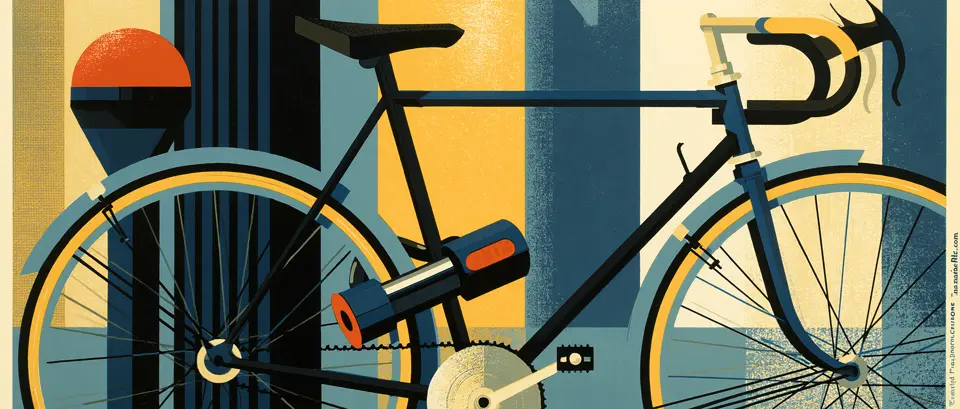
Anti-theft basics: locks, and where not to leave the bike
No lock is unbreakable — but most bike theft is opportunistic, and a bit of method rather than paranoia drops your odds of losing it sharply.
The goal is not an unstealable bike; there's no such thing. A determined thief with an angle-grinder beats any lock ever made, given enough time and enough quiet. The goal is smaller and far more achievable: make your bike cost more time, noise and effort than it's worth, and make it a worse bet than the bike parked next to it. Almost all bike theft is opportunistic, so most of what follows is about removing the easy opportunity.
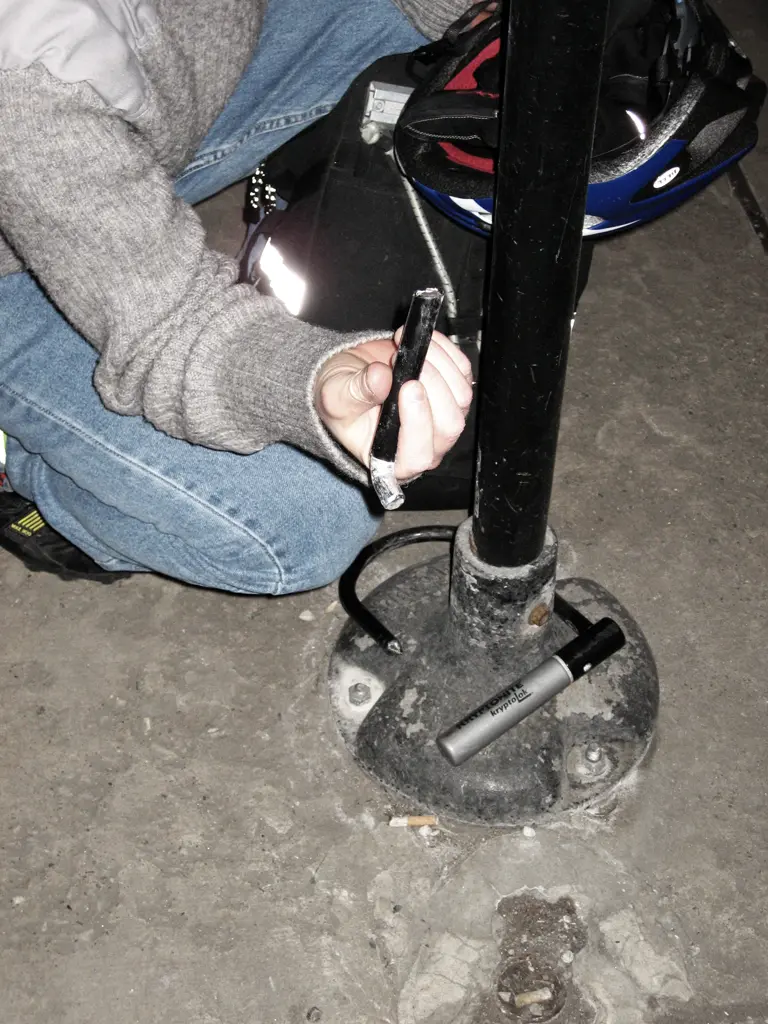
No lock is unbreakable: even a U-lock yields to the right tool. That's why the game is time and cost. Photo David B. Gleason · CC BY-SA 2.0 · Wikimedia Commons
Start with an honest limit. Uruguay publishes no bike-specific theft figures — the Interior Ministry reports overall theft numbers, which have been drifting down in recent years, but nothing broken out for bicycles, and there is no official bike registry or marking scheme. So treat the advice below as general good practice, not as a response to a measured local threat.
The lock is where the money goes, and where most of it is wasted. Spend too little and you've protected nothing; the cheap cable lock coiled around a wheel is security theatre, cut in seconds, and no substitute for a real lock. A hardened U-lock (also called a D-lock) is the sensible default for city use: the best balance of security and price, hard to leverage or cut if the shackle gap is small. A hardened chain is heavier but wraps awkward anchors a rigid U-lock can't reach. Folding locks are often pitched as a middle ground — more flexible than a U-lock, sturdier than a cable — though independent testers like the UK's Sold Secure rate them across the same scale as everything else rather than slotting them neatly in between, so judge the individual lock, not the category. As a rule of thumb, put a sensible fraction of the bike's value into the lock; the best-known international brands aren't always easy to find locally, so you may have to ask around or order ahead.
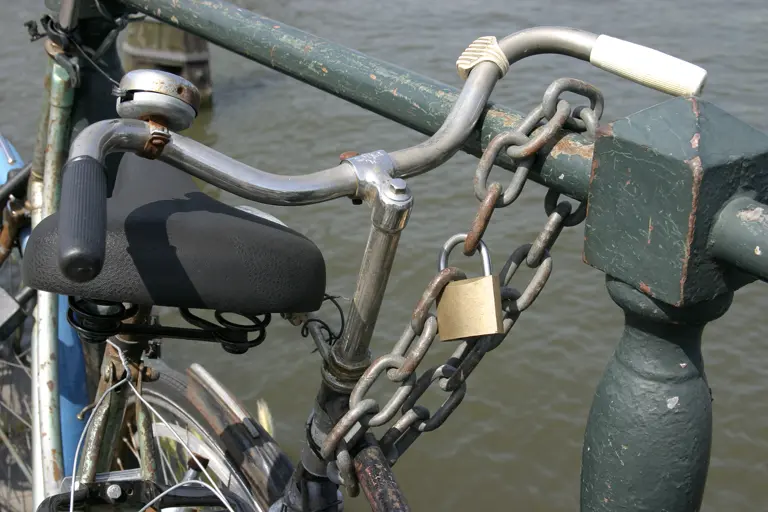
The hardened chain: heavy but flexible, for locking where the U-lock won't reach. Photo Nino Barbieri · CC BY-SA 2.5 · Wikimedia Commons
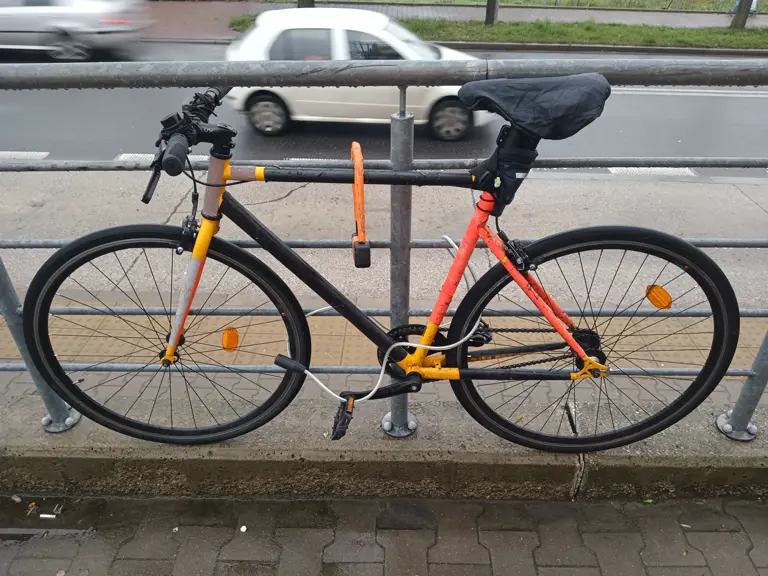
The goal: frame and wheels secured to a fixed point, U-lock and cable combined. Source WrS.tm.pl · Wikimedia Commons · Public domain
Then lock it properly — this is the part most people get wrong. Pass the lock through the frame, not just a wheel: a lock around the front wheel alone leaves you holding a wheel while the bike is gone. The most secure single-lock position runs through the rear wheel and the rear triangle of the frame at once, both caught against a fixed anchor. Fill as much of the U's empty space as you can — a packed shackle gives leverage tools nothing to bite on. Keep the lock up off the ground rather than resting on the pavement, since a hard surface underneath gives a thief something to smash the lock against. Choose an anchor that can't be cut or lifted away — an inverted-U municipal rack is ideal; a thin sign-post the bike can be slid up and over is not. And remember the quick-release parts: a wheel or saddle on a quick-release skewer walks off on its own unless it's secured or swapped for bolts. For a valuable bike, two locks of different types — one on the frame and rear wheel, another on the front wheel — force a thief to carry and use two sets of tools, which is often enough to send them elsewhere.
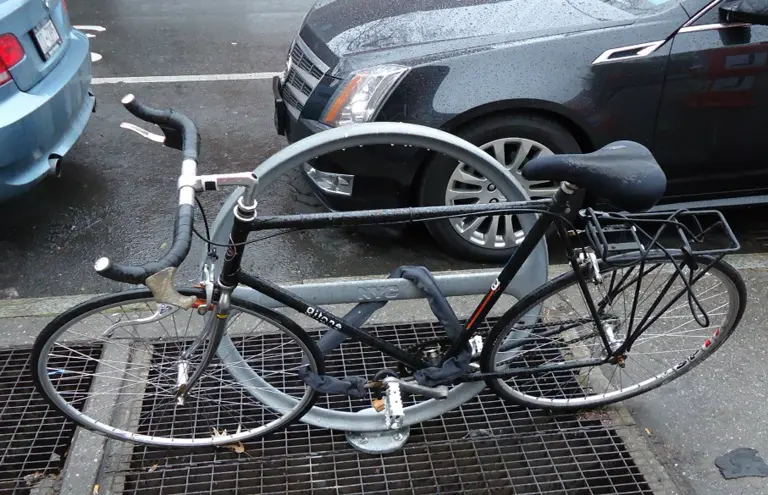
Lock to a fixed anchor, in plain sight with people around: the best free lock there is. Source Tomwsulcer · Wikimedia Commons · CC0
Where you leave it matters as much as how. A bike left out overnight, in an empty street, in the same predictable spot every day, invites the patient thief who comes back prepared. A busy, well-lit, overlooked place is a free layer of security; indoors is better still. If you have any choice at all, that choice is the cheapest protection you'll ever get.
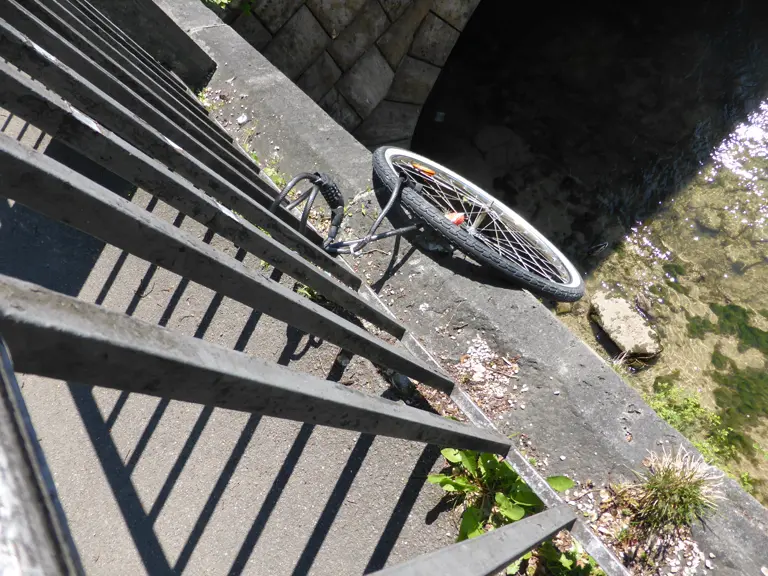
What a lapse leaves behind: a stripped frame. Most bikes are lost to where and how they were left. Source MartinThoma · Wikimedia Commons · CC0
Finally, prepare for the day it goes anyway, because Uruguay gives you no official system to fall back on. Photograph the bike. Write down the frame's serial number — usually, though not always, stamped underneath the bottom bracket. Keep the purchase receipt. With those three things, the denuncia — the police report that is your only legal record here — becomes something that can actually identify the bike if it turns up, rather than a formality. None of this is paranoia; it's method. Done once, it costs you an afternoon, and it's the difference between a stolen bike that's simply gone and one you have a genuine chance of getting back.
- BikeRadar — Sold Secure lock ratings explained: how the independent UK testing standard rates locks; cable locks rate lowest of all lock types, and the dual-lock strategy is a tested recommendation for higher-value bikes.Accessed 3 · JUL · 2026
- Decathlon Uruguay — B'Twin lock range: own-brand chain locks roughly $2,090–3,190 Uruguayan pesos, cable/basic locks around $490–990. Prices volatile — check the current one.Accessed 3 · JUL · 2026
- MercadoLibre Uruguay — bike locks: a wide range — cables ~$200–500 (minimal security), U-locks ~$500–1,000, mid-range chains ~$2,000–3,000 Uruguayan pesos. Prices volatile — check the current one.Accessed 3 · JUL · 2026
- Ministerio del Interior (Uruguay) — crime statistics: Uruguay reports only aggregate theft figures — no bike-specific breakdown, and no official bike registry or marking program.Accessed 3 · JUL · 2026