
Colonia del Sacramento by bike: the historic quarter
Colonia's Barrio Histórico — its historic quarter — is a World Heritage Site, and you can take it in over an afternoon. But here's a truth worth saying up front: much of it is better seen on foot. The bike gets you here, and carries you far along the waterfront; the Portuguese cobblestone, though, asks you to dismount. This is an honest guide to the landmarks, and to where you'll walk the bike alongside you.
Few places tell their history as plainly as Colonia. The town changed hands again and again between the Portuguese and the Spanish, and each side left its mark on top of the other's: an irregular Portuguese street that follows the terrain, a church of Portuguese stone and Spanish brick, a gate with a coat of arms that spent two centuries on the far side of the river. The historic quarter is, literally, a palimpsest. And the 17th-century cobblestone is the first layer you feel under the wheels.
So the bike plays a precise role: it's for getting to Colonia and for circling the quarter along the coast, not for threading the roughest little lanes of the centre. Inside the casco — the old core, small and cobbled, with short blocks — you'll enjoy it more on foot. That isn't a limitation: it's the plan.
A town that kept changing owners
The Portuguese founded Colonia on 28 January 1680, across the river from Buenos Aires, as an outpost on the Río de la Plata. What followed was a century of tug-of-war: the town changed hands repeatedly between 1680 and 1777, when Spain occupied it for good. That dispute is what explains everything you see. While the Spanish crown imposed its perfect grid on its cities, Colonia kept the irregular Portuguese street plan, which fits the terrain instead of taming it. For that singularity — a street plan that breaks from the Spanish grid — UNESCO inscribed it as a World Heritage Site in 1995.
The landmarks
The Portón de Campo (the field gate) is the entrance to the quarter, and the best place to begin. The Portuguese governor Antonio Pedro de Vasconcellos built it in 1745; the stone was carved in Rio de Janeiro and shipped over. Torn down in 1857, the gate you cross today — moat and bridge included — is the 1968–71 reconstruction. Above the gate there was once a Portuguese coat of arms which, when Spain took the city in 1777, was torn off and carried to Buenos Aires. It stayed there 219 years: only in 1996 did it return to Colonia. What you see on the gate today is a replica; the original is in the Museo Portugués (the Portuguese Museum), a few blocks away.
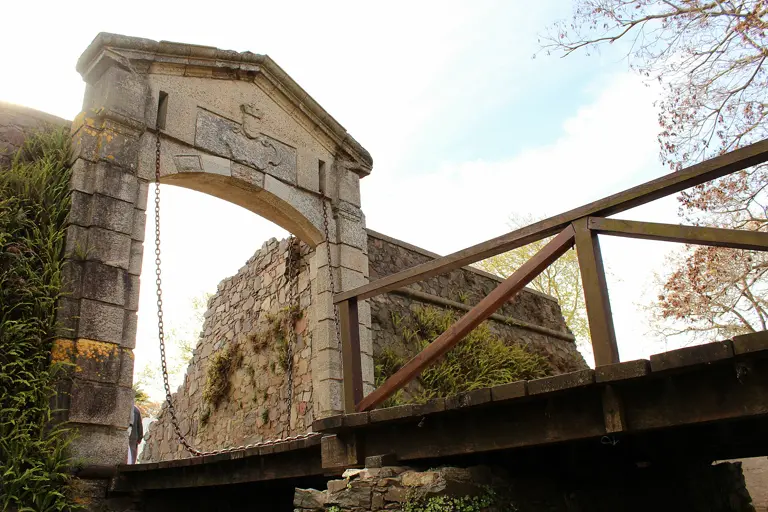
"Begin here: the Portón de Campo, the field gate the Portuguese first built in 1745 — demolished in 1857, rebuilt in 1968–71, moat and bridge included. Look up for the coat of arms — a replica; Buenos Aires kept the original for 219 years." Photo Huguitoportal · CC BY-SA 3.0 · Wikimedia Commons
The Calle de los Suspiros — the Street of Sighs — is Colonia's signature image, and the perfect example of when to get off. It's barely fifty metres of wedge-stone cobble, with no kerbs, with steps and plane trees on either side. On a bike it's awkward and clumsy; on foot it's one of the loveliest streets in the country. Here, without question, you walk the bike alongside you.
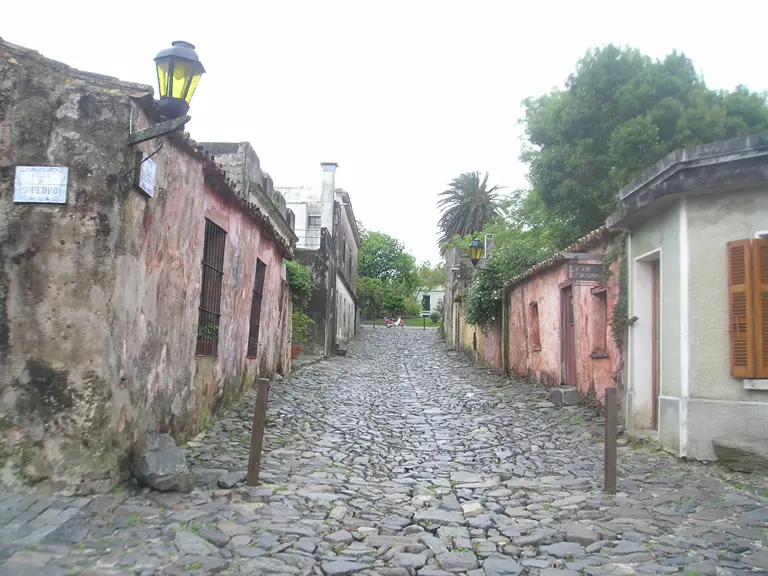
"Fifty-odd metres of wedge-set cobble make up the Calle de los Suspiros, the Street of Sighs. You don’t ride this stretch; you walk the bike through." Photo Heretiq · CC BY-SA 3.0 · Wikimedia Commons
The Basílica del Santísimo Sacramento, on the square, is among Uruguay's oldest churches: the parish was founded in 1680, the year the city was founded, and the present building dates from 1808–1810, by the architect Tomás Toribio. It has its own palimpsest story — walls of Portuguese stone and Spanish brick — and an anecdote to match: when it served as a powder magazine, a lightning strike blew it up, and Darwin himself, passing through the Río de la Plata, noted in his Beagle diary that the explosion brought down two-thirds of the building.
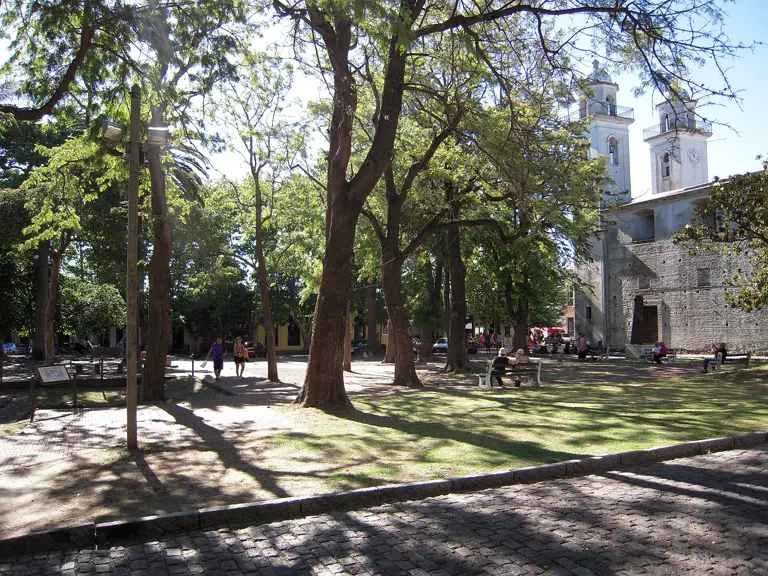
"The Plaza de Armas, with the Basílica del Santísimo Sacramento wearing both empires at once: walls part Portuguese stone, part Spanish brick." Photo Helge Høifødt · CC BY-SA 3.0 · Wikimedia Commons
The Faro (the lighthouse), from 1857, rises on the ruins of the old San Francisco Xavier convent. Climbing the lighthouse is the best way to grasp the quarter: from the top you see the whole street plan, the square, the river, and why this small patch of land was worth so many wars.
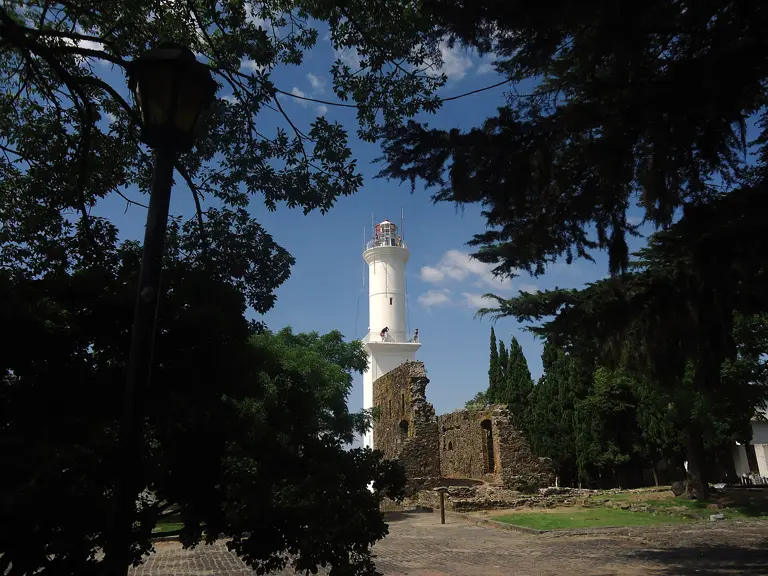
"Climb the 1857 lighthouse — it stands on what was once the San Francisco Xavier convent — and the whole quarter arranges itself below you." Photo Andrea Arriola · CC BY-SA 3.0 · Wikimedia Commons
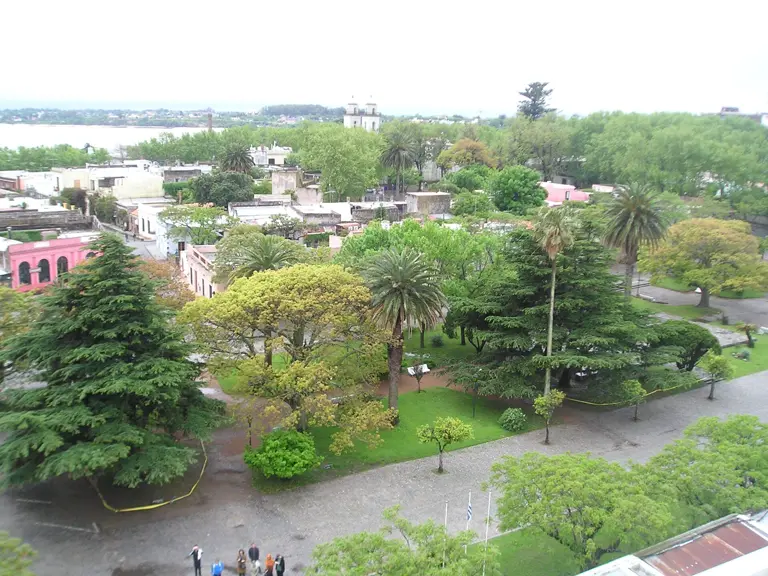
"From up there, the Plaza Mayor and the street plan around it: irregular, Portuguese, and the reason UNESCO listed the quarter in 1995." Photo Heretiq · CC BY-SA 3.0 · Wikimedia Commons
The Bastión del Carmen (the Carmen bastion), at the edge of the quarter, blends Colonia's two lives: an old Portuguese colonial fortification and, on top of it, an industrial chimney from 1880, from when the site was a factory. Today it's a cultural centre. Being on the outer ring, it's one of the landmarks worth reaching by bike.
By bike or on foot
The rule is simple, and holds for almost any heritage town in the world: the bike is the means, not the protagonist. You arrive pedalling, lock the bike well at the edge of the casco, and walk in to the cobbled lanes — the centre is small, crossed in minutes. To move quickly again, the rambla costanera (the coastal promenade) that rings the quarter is ideal on a bike: flat, the river alongside, and it connects the outer-ring sites (the Bastión del Carmen, the old port). Before heading out on the shared streets, a look at how to ride safely never hurts; and if you need to rent a bike in Colonia, the directory has options.
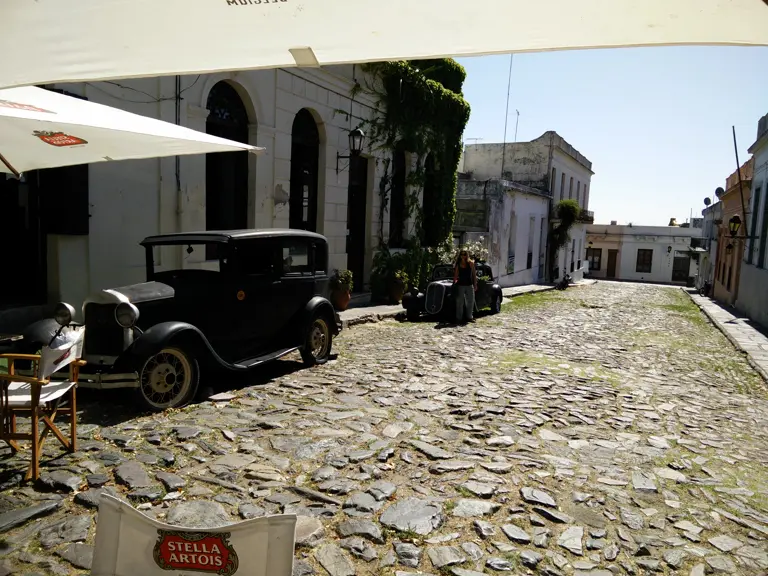
"Colonia’s other constant: the vintage cars parked around the quarter, as familiar here as the cobblestone." Photo pedaleando.uy · December 2015
Practical box — the casco by bike and on foot
On foot (dismount). The Calle de los Suspiros (wedge-stone cobble, steps), the central lanes around the Plaza Mayor, the climbs to the Faro and the Basílica. The quarter is small: an afternoon's walk.
By bike. Getting to Colonia; the coastal promenade ringing the quarter; the outer-ring sites (Bastión del Carmen, old port). A city or gravel bike handles cobblestone better than a road bike.
The landmarks. Portón de Campo (1745, rebuilt 1968–71, with its moat and the replica coat of arms), Calle de los Suspiros, Basílica del Santísimo Sacramento, Faro (1857), Plaza Mayor, Museo Portugués, Bastión del Carmen.
The bike. U-lock at the edge of the casco; inside, you walk.
- Wikipedia — Colonia del Sacramento (founding 1680, colonial dispute, UNESCO inscription 1995).Read 26 · JUN · 2026
- Wikipedia (English) — Colonia del Sacramento (Portuguese street plan, timeline of the seven changes of hands 1680-1777).Read 26 · JUN · 2026
- Wikipedia — Basílica del Santísimo Sacramento (parish founded 1680, building 1808-1810, architect Tomás Toribio, the powder-magazine explosion).Read 26 · JUN · 2026
- Museos de Colonia — Escudo de piedra del Portón de Campo (built 1745 by Vasconcellos, stone carved in Rio de Janeiro, the coat of arms and its 219 years in Buenos Aires).Read 26 · JUN · 2026
- Viaje a Colonia Uruguay — Portón de Campo.Read 26 · JUN · 2026
- Infoturismo19 — Murallas y Portón de Campo (demolished 1857 under president Gabriel Pereyra; rebuilt 1968-1971 by the Consejo Ejecutivo Honorario de las Obras de Restauración de la Antigua Colonia del Sacramento).Read 10 · AUG · 2026