
Montevideo
The city by bike: the Rambla, the bike lanes, and the everyday business of getting around Montevideo.
Montevideo shows up twice in these accounts: as a place to arrive — the finish line of a coastal crossing — and as a city its own residents ride every day. The numbers point to the second. By an April 2026 tally, close to a quarter of Uruguayans ride at least once a week, the capital counts some seventy-seven kilometres of bike lane, and traffic on the 18 de Julio lane is up about seventy per cent year on year, averaging near 1,400 trips a day. That's modest next to Buenos Aires's three hundred and ten and Greater Santiago's roughly four hundred and eighty. Behind the figures is the lived version — six years of commuting by bike in one rider's memoir — and, running through all of it, the Rambla, the long waterfront road that pedestrians, skaters and cyclists share for the length of the city, whose own infrastructure story runs deeper than a directory page can.
The other views of the city and its mobility can be explored and sorted by country, language, year or depth alongside the rest of the library; below, five of the most thorough on cycling Montevideo.
Epic Road Rides — the inside guide
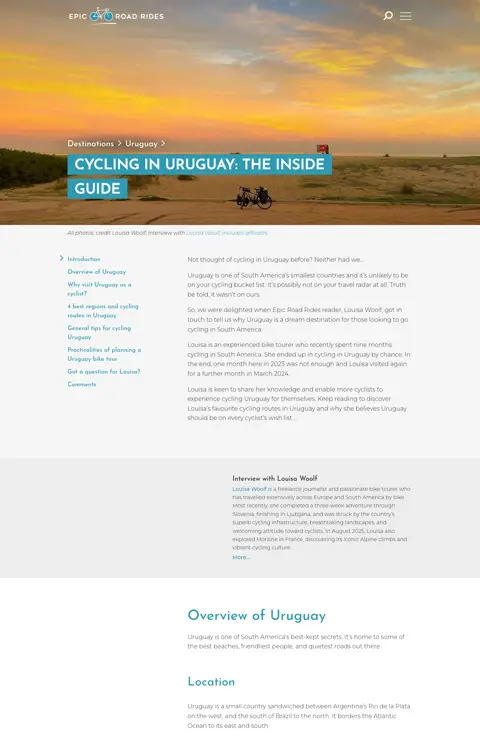
The most comprehensive English-language guide to riding Uruguay is the work of Louisa Woolf, a British journalist who came twice, in 2023 and 2024, and wrote the country up in full: what the roads and the traffic are like, where to sleep and eat, what it costs, when to come. Her verdict — flat, safe, welcoming, best in March — comes with departmental deep-dives for Rocha, Maldonado and Colonia, and a soft spot for the wine country and the arts town of Pueblo Garzón.
Leonardo Mendes — Chuí to Montevideo
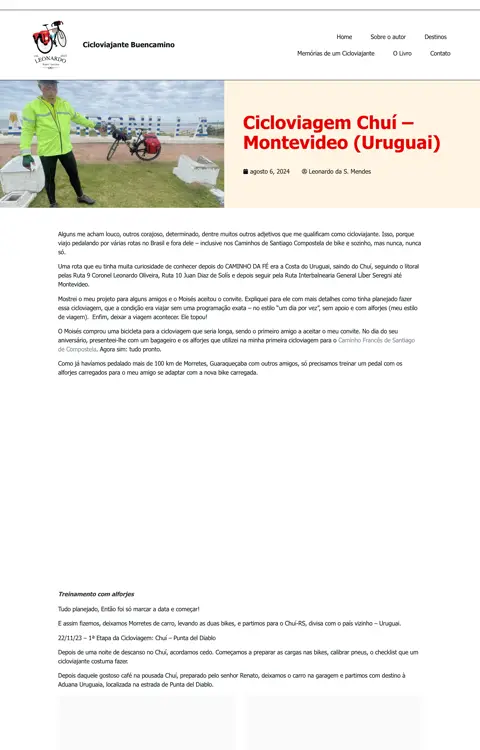
Leonardo Mendes and his companion Moisés rode the 411 kilometres from the Brazilian border down to the capital in November 2023 — six days, six stages, logged in close GPS detail. Theirs is a hotel-to-hotel trip full of incident: a rear rack lashed back together with wire, the boatman Pepe Lobato rowing the two of them across the Laguna de Rocha, the long dirt haul toward Garzón, the sea-lion colony at Cabo Polonio. It's among the most complete recent records of the coastal run into Montevideo.
Prensa Mercosur — the numbers
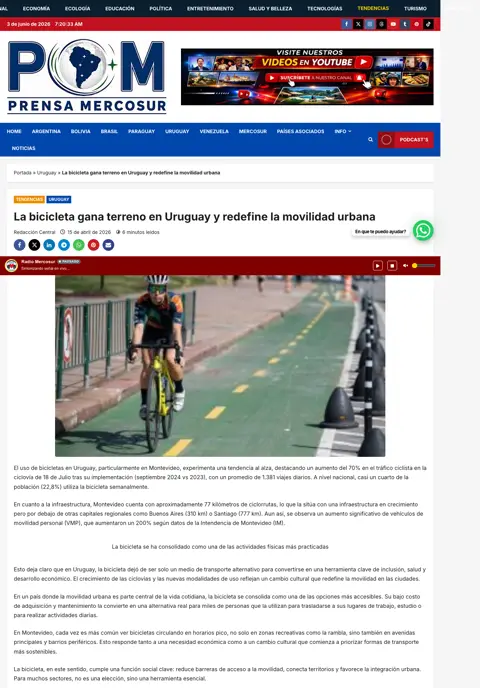
Not a ride but the data behind the trend: an April 2026 report finding that close to a quarter of Uruguayans now cycle weekly, that traffic on the 18 de Julio lane is up about seventy per cent year on year, and that Montevideo's roughly seventy-seven kilometres of bike lane still sit well behind Buenos Aires and Santiago, even as e-bike and scooter use has tripled.
Damián Muraña — six years on two wheels
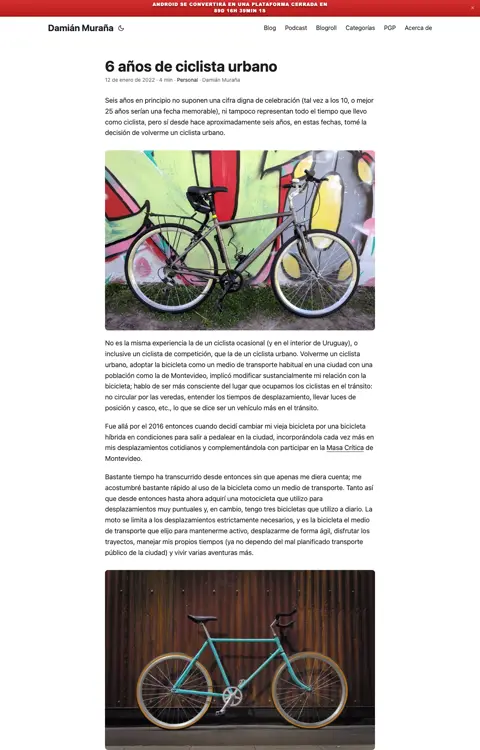
A Montevideo rider set down what six years of everyday cycling in the city taught him: that the bike freed him from bus timetables, that in all that daily riding he never had one stolen or came off badly, and that the network's gaps are as real as its progress. He rides Critical Mass, put together his own fixed-gear from parts, and points readers to the corners of the local scene — the forums, the Musimóvil crowd — where the rest gets argued out.
Komoot — six rides around Montevideo
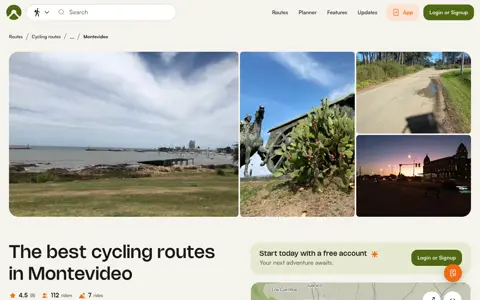
A route-planning platform's set of mapped city rides, from short Pocitos and Rambla loops to a ninety-kilometre Arroyo Carrasco circuit, each with a downloadable GPS track and community ratings — a practical starting point for a visitor with a bike and a free day.
- Prensa Mercosur — the April 2026 urban-mobility survey behind the group's figures: weekly ridership near a quarter of the population, about 1,400 daily trips on the 18 de Julio lane, 77 km of bike lanes in Montevideo, 310 km in Buenos Aires. Its Santiago figure (777 km) refers to the whole Metropolitan Region, not Greater Santiago.Accessed 25 · JUL · 2026
- The Clinic — Greater Santiago Master Plan: around 480 km existing, of which ~80% doesn't meet the current technical standard by the regional government's own account; 820 km target by 2035.Accessed 25 · JUL · 2026