← Community
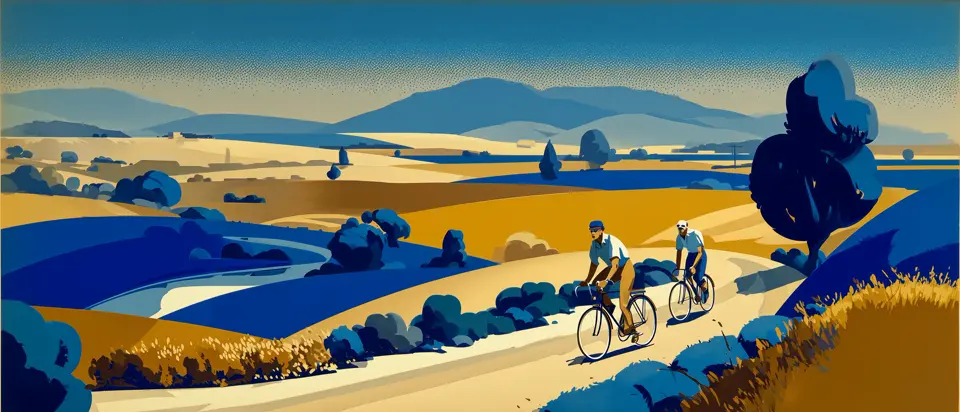
Illustration: a cyclist on a rural road through Uruguay's interior among soft hills. 1920s poster style.
Illustration · Midjourney
— Community · Cycle-touring directory

The interior

Far from the coast: whole-country journeys and the deep interior, told almost always by Uruguayans themselves.

If the coast is told mostly by outsiders, the interior is told, almost always, by Uruguayans themselves. This is the smallest group in the directory and, at the same time, the most singular: instead of following the line of the sea, its protagonists head inland, toward the northern departments — Artigas, Rivera, Tacuarembó, Durazno — that almost no coastal account mentions. Whole-country projects appear: four thousand, six thousand kilometers, the nineteen departments, nearly all their capitals, ridden in a spare style, without paid lodging, sleeping wherever people open the door of their home. One image returns again and again: here the land is all private and fenced, so wild camping gets complicated and hospitality becomes infrastructure. The unpaved back roads return, chosen on purpose over the national highways; the cuchillas — the low ridges that add climbing without your noticing; the southerly wind; the towns every thirty kilometers; the gaucho herders in their berets, the shared mate gourd passed hand to hand. And the community returns: the first Encuentro Nacional de Cicloviajeros — the national gathering of bike travelers — with more than a hundred people camping in Casupá; the groups born in the pandemic that value a twenty-kilometer loop as much as a long crossing. Alongside the first-person accounts come planning resources — repositories of GPX tracks for bikepacking and gravel that cover regions no one documents in prose. It's the least-photographed Uruguay and, for many, the most authentic: the one that appears when you turn away from the coast.

The rest of the trips that head inland are gathered and can be sorted by depth, country, language or year; below, five of the most thorough on the interior.

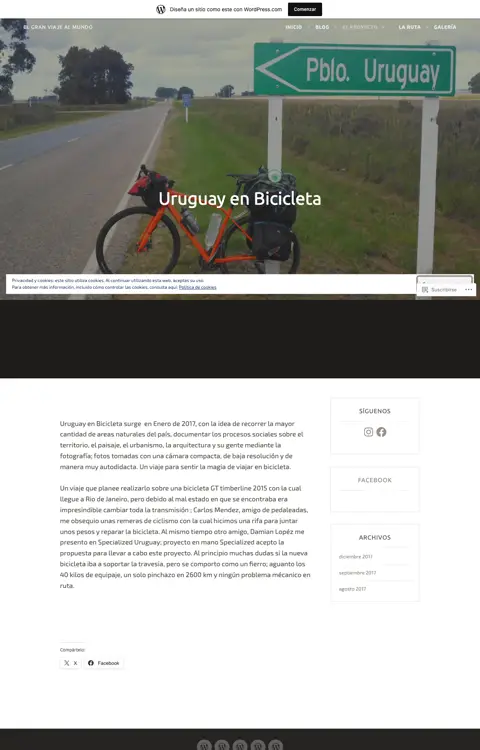
El Gran Viaje al Mundo: "2,600 km of nature reserves, told through the camera"

Screenshot of elgranviajealmundo.wordpress.com/uruguay-en-bicicleta
elgranviajealmundo.wordpress.com/uruguay-en-bicicletacaptured 3 June 2026

A Uruguayan project that crosses the country from within on a different premise: it's not a travel diary, it's a documentary photography work over 2,600 kilometers of nature reserves. It records territory, landscape, urbanism, architecture and people, backed by Specialized Uruguay and community funding as local as raffling off T-shirts. The small numbers paint the rest: a single puncture in 2,600 kilometers, the whole drivetrain replaced halfway, a January start. It's the kind of view that barely exists among the foreign coast-focused accounts — an author's framing of the interior — and that's why it heads this group, even though the page doesn't lay out the itinerary kilometer by kilometer.

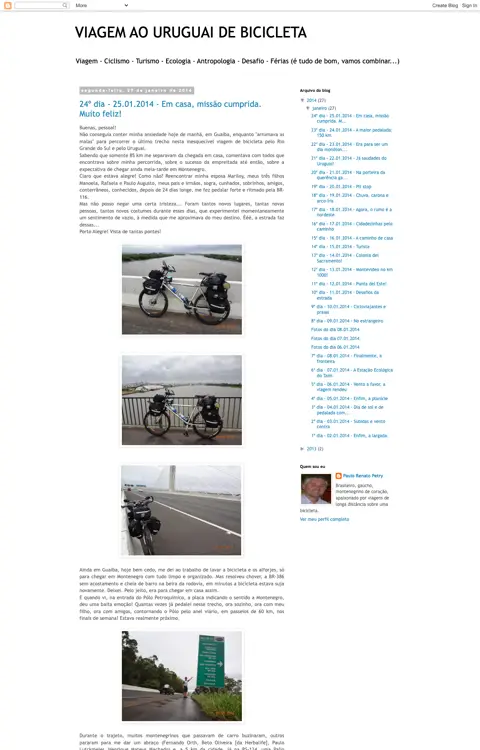
Paulo Petry: "2,155 km solo, far from the coastal corridor"

Screenshot of viagemaouruguaidebicicleta.blogspot.com
viagemaouruguaidebicicleta.blogspot.comcaptured 3 June 2026

An experienced Brazilian does what almost no one does: he heads toward Colonia and the interior, away from the classic coastal corridor, crossing at the little-used Jaguarão border. It's 2,155 kilometers in 24 days of January, solo, with daily posts and more than 150 articles loaded to stay self-sufficient. What's different is the gaze: Petry crosses ecology and anthropology with the riding, so his diary watches the landscape as much as the people. He confirms a recurring theme — Uruguayan drivers "notably more courteous" than Brazilian ones — and fights the usual foes, headwind and storms. One of the few entries to document the less-traveled crossing and the return through the interior.

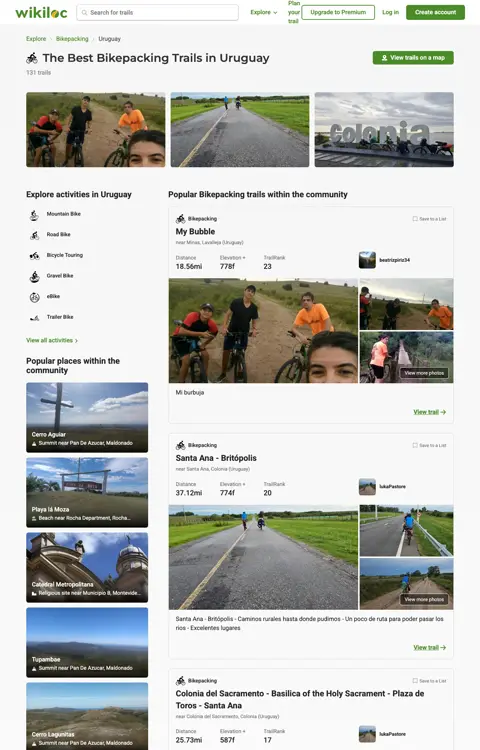
Wikiloc: "The GPX tracks the community left marked, ready to download"

Screenshot of wikiloc.com/trails/bikepacking/uruguay
wikiloc.com/trails/bikepacking/uruguaycaptured 3 June 2026

Not an account but a tool, and that's why it's key in this group: the repository of bikepacking GPX tracks the community has been uploading for Uruguay, downloadable to navigate. It covers coastal and inland routes — Colonia, Lavalleja, the area around Montevideo — with rides ranging from about 29 to more than 100 kilometers, and sits alongside sister categories for cycle touring, MTB and gravel. Where the prose diaries rarely reach the north and the back roads, the community tracks do: they mark what no one wrote down. It's the practical complement to the author-driven accounts, the thing that turns inspiration into a route loaded on the GPS before you leave.

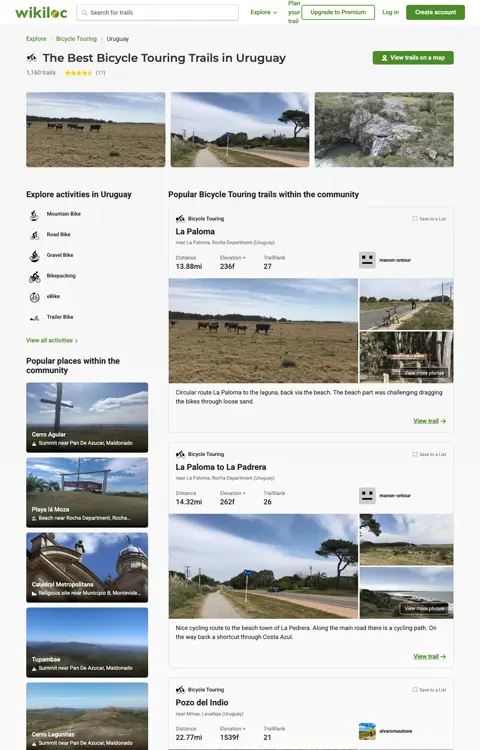
Wikiloc: "The cycle-touring variant, with sub-pages from La Paloma to Colonia"

Screenshot of wikiloc.com/trails/bicycle-touring/uruguay
wikiloc.com/trails/bicycle-touring/uruguaycaptured 3 June 2026

The cycle-touring face of the same community repository, a direct complement to the bikepacking guide. It gathers GPX tracks specific to bike travel through Uruguay, with sub-pages dedicated to La Paloma, Punta del Este and Colonia del Sacramento, spanning both the coast and the interior. Taken together, the two Wikiloc collections are the reference GPX resource for planning a crossing of the country: what an account stirs up as desire, these pages leave ready to load and follow. For anyone building a route through the interior, where written documentation is scarce, they're the most reliable cartographic starting point.

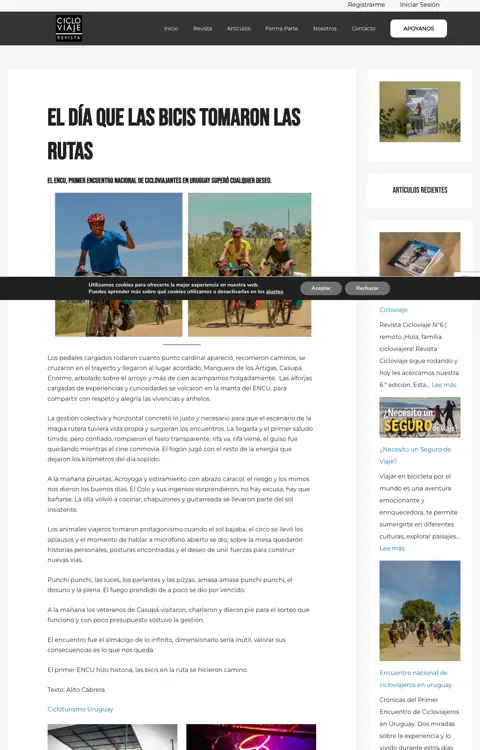
ENCU — the national bike-travelers' gathering: "More than a hundred camping in Casupá, and a community discovering itself"

Screenshot of revistacicloviaje.com/encu-encuentro-nacional-de-cicloviajeros-en-uruguay
revistacicloviaje.com/encu-encuentro-nacional-de-cicloviajeros-en-uruguaycaptured 3 June 2026

Not a route chronicle but a community one, and that's why it closes this group: the account of the first Encuentro Nacional de Cicloviajeros Uruguayos — the national gathering of Uruguayan bike travelers — with more than a hundred people camping in Casupá, in the department of Florida. It tells of a horizontal, collective organization — yoga, swimming, music, campfires — and a solidarity that defines the local scene more than any mileage. It records a founding moment: the country's cycling community gathering at that scale for the first time, with the promise of many gatherings to come. To understand why the interior is told by Uruguayans themselves, read this: here is the human fabric that nearly all the other accounts in this group come out of.