Montevideo is learning to ride
Not the Uruguay of long journeys, but the everyday one — a capital slowly rebuilding itself around the bicycle, one waterfront and one avenue at a time.
There is a Uruguay on bicycles that has nothing to do with long journeys — the everyday one — and its stage is almost always Montevideo. It is two things living side by side: the city as a place to ride for pleasure, and the city as a system for getting around. By early 2026 the numbers had started to catch up with the feeling. A mobility survey reported that roughly a fifth of the population rides at least once a week, that traffic on the 18 de Julio bike lane had grown about seventy percent year over year, and that the city had something like seventy-seven kilometres of protected lanes — modest beside Buenos Aires's three hundred and ten or Greater Santiago's roughly four hundred and eighty, but expanding fast.1
The physical spine of all of it is the Rambla, the waterfront road and walk that runs the length of the city. It is the stretch every visitor guide names, the one that runs from a proper bike lane behind the parked cars to a two-way path along the pavement, the one shared by walkers, skaters, and cyclists at once. For a long time it was also the limit of the city's cycling ambition. In the last few years that changed.
In December 2023 the city ran a four-kilometre protected lane straight down its civic axis, 18 de Julio, linking the Obelisco to Plaza Independencia and changing the geometry of the capital's main avenue.2 It went in fast — a little over a month — and not without argument: some architects and cycling collectives called the central, two-way design unsafe and questioned why it ran down the middle of the avenue rather than along its edge.3 The counts that followed, published by the city, showed steady growth all the same.4
Then, in September 2024, came the move that mattered most symbolically: 4.7 kilometres of two-way lane on the Rambla itself, from the Escollera Sarandí breakwater to the Parque Rodó. What set it apart was where it ran — not up on the footpath, like the seafront bike paths before it, but down on the roadway, protected under the city's own modelo Quijano by a buffer of parked cars.5 East of the Parque Rodó the protected lane gives way to an older footpath that carries the route on toward the Prefectura naval station in Pocitos; further east — Buceo, Malvín, Punta Gorda, Carrasco — the Rambla is shared with traffic again.
The longest continuous stretch, though, is not in Montevideo at all. In November 2025 the neighbouring department of Canelones closed the last gap in its coastal path, leaving about 12.7 kilometres of continuous, traffic-separated riding from El Pinar to the arroyo Carrasco, at the Montevideo border.6 On the Montevideo side of that stream the corridor does not yet continue — the capital's eastern rambla still has no cycle infrastructure — which is the gap the city now talks about closing.
What comes next is a question of will and budget. In May 2026 the city confirmed it would begin building an eleven-kilometre lane to connect the working-class Cerro, in the west, with the centre — its most ambitious single stretch yet.7 A southern leg down Bulevar Artigas, long discussed, still has no start date. The plan, stated more than once, is to bring the network to a hundred kilometres.
The full network — and how much of it a visitor can ride without sharing the road — is easiest to see laid flat.
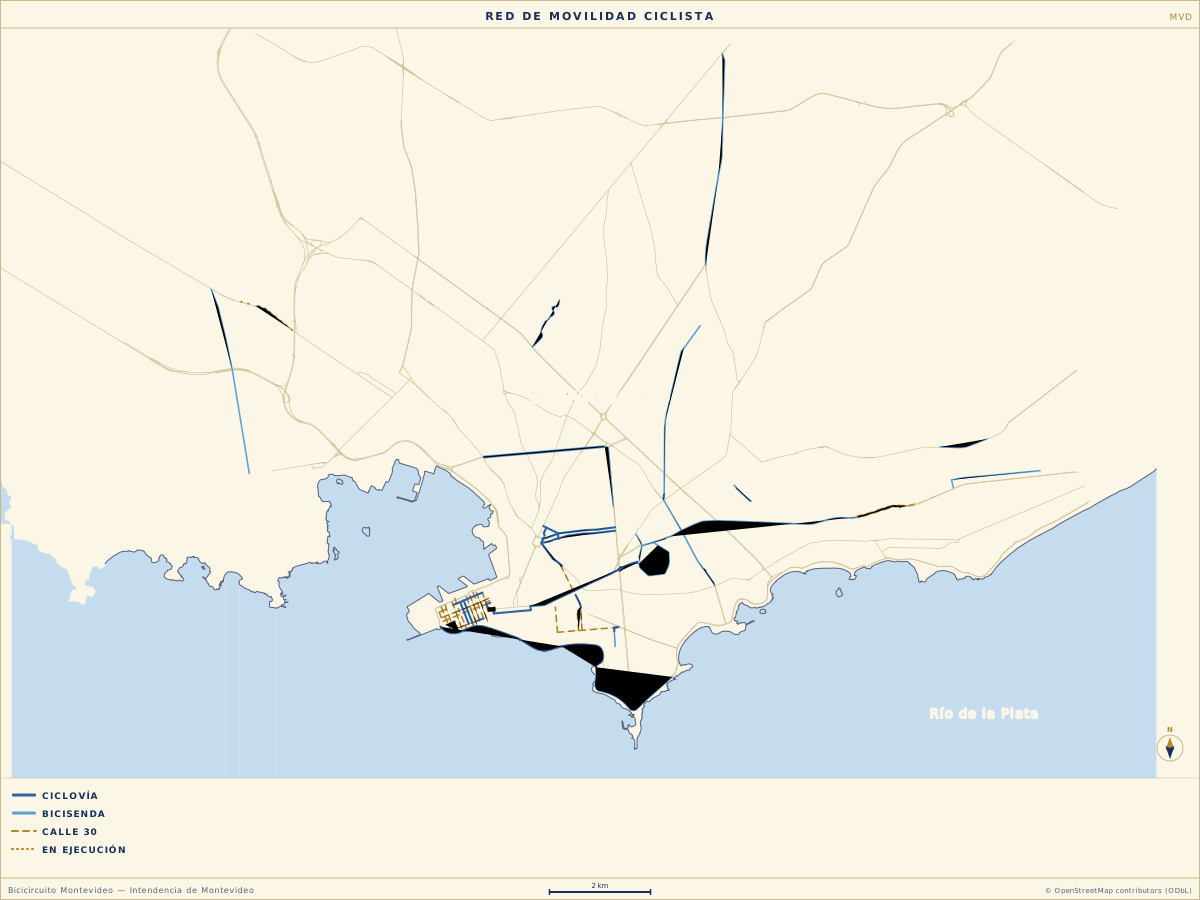
Network data: Intendencia de Montevideo.
None of this is finished, and the people who ride here every day are the first to say so. The most clear-eyed account of urban cycling in Montevideo comes from a rider who logged six years of daily commuting without a single theft or serious crash — and an honest inventory of what fails: lanes blocked by parked cars, enforcement that doesn't enforce, gaps where the network simply stops.8 Around that everyday riding a culture has grown — the city's Critical Mass, the online communities, the fixed-gear bikes built from nothing — that treats the bicycle less as sport than as a way out of the bus timetable.
And Montevideo keeps its older role too. It is where so many of the coastal journeys, the ones that begin days away at the Brazilian border, finally end.
- Prensa Mercosur. "La bicicleta gana terreno en Uruguay y redefine la movilidad urbana." prensamercosur.org, abr. 2026.Accessed 16 · JUN · 2026
- Intendencia de Montevideo. "Quedó inaugurada la ciclovía de la avenida 18 de Julio." montevideo.gub.uy.Accessed 16 · JUN · 2026
- El Observador. "El enojo de los colectivos de ciclistas con la IM por la ciclovía en 18 de Julio…" elobservador.com.uy.Accessed 16 · JUN · 2026
- La Diaria. "Crece de forma sostenida la cantidad de bicicletas… en 18 de Julio por la ciclovía." ladiaria.com.uy, abr. 2024.Accessed 16 · JUN · 2026
- Intendencia de Montevideo. "Con la nueva ciclovía de la rambla, Montevideo alcanza casi 80 km de infraestructura para bicicletas." montevideo.gub.uy, 21 Sept 2024.Accessed 16 · JUN · 2026
- El Observador. "Modelo Quijano, velocidades y controles: todos los detalles de la ciclovía de Rambla Sur." elobservador.com.uy, 24 abr. 2024.Accessed 16 · JUN · 2026
- Intendencia de Canelones. "Nuevo tramo del paseo costero conecta Canelones y Montevideo." imcanelones.gub.uy.Accessed 16 · JUN · 2026
- El Observador. "Intendencia de Montevideo comenzará este año la construcción de la ciclovía al oeste que unirá el Cerro con 18 de Julio." elobservador.com.uy.Accessed 16 · JUN · 2026
- Muraña, Damián. "6 años de ciclista urbano." damian.murana.uy.Accessed 16 · JUN · 2026