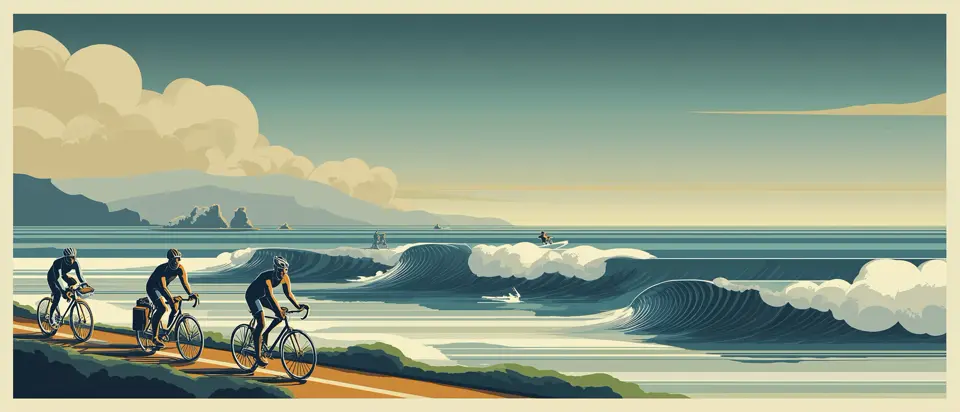
The Atlantic coast
No route in Uruguay has been ridden — or written up — more than the coast from Chuy to Montevideo, through Rocha and Maldonado.
More cyclists have ridden the Atlantic coast than any other part of Uruguay, and enough of them have written it down that the route almost narrates itself. It runs from the Brazilian border at Chuy down to Montevideo, through Rocha and Maldonado — more than six hundred kilometres of coastline in a country flat enough that a first tour won't punish you; the highest ground in Uruguay barely clears five hundred metres. The main roads are paved, and the drivers, by most accounts, patient. The wind is the steadier companion. It blows at much the same modest speed all year, but for most of the year it comes out of the east and northeast — a headwind on the way up the coast toward Brazil, a hand at your back on the way home.
Then the pavement runs out. Between the Laguna de Rocha and Garzón, some forty kilometres of dirt turn, after rain, into the stretch every rider seems to remember; the lagoon itself has long been crossed by chalana, a flat barge a local boatman poles across with the bikes aboard — though it's worth confirming the service still runs before you count on it. Cabo Polonio is its own kind of interruption: a car-free village inside a national park, with no paved road in and no riding allowed past the gate. You leave the bike at the park office on Ruta 10 — covered storage for about a hundred Uruguayan pesos a day, or free in the open air — and then either walk the seven kilometres over the dunes or ride across on one of the 4×4 trucks that make the crossing (around 470 Uruguayan pesos return). There is no mains electricity, one small and expensive shop, and a colony of sea lions below an 1881 lighthouse.
Further on come the set pieces: Santa Teresa, with a campground as well known as any in the country and a fort begun in 1762; the flamingos on the Laguna de Rocha; the hostels of La Pedrera and Valizas; and, at Punta del Este, La Mano — the giant concrete fingers that rise out of the sand at Playa Brava, planted there by a Chilean sculptor in 1982. What surprises many riders is the welcome they find; what catches them out is the calendar. Much of this coast runs on the season, and from April to November a good share of the hostels and campgrounds simply close. In Rocha the window worth aiming for is December to February; a little further south in Maldonado, March stays warm and sunny and cheaper, with the bars and restaurants still open. The accounts gathered below come from all over — Uruguayan, British, Brazilian — and they are only a curated handful of a much longer list.
These five are a place to start. The full directory of first-hand rides — filterable by route, distance and where the riders came from — lives in the ride library.
Epic Road Rides — the Rocha guide
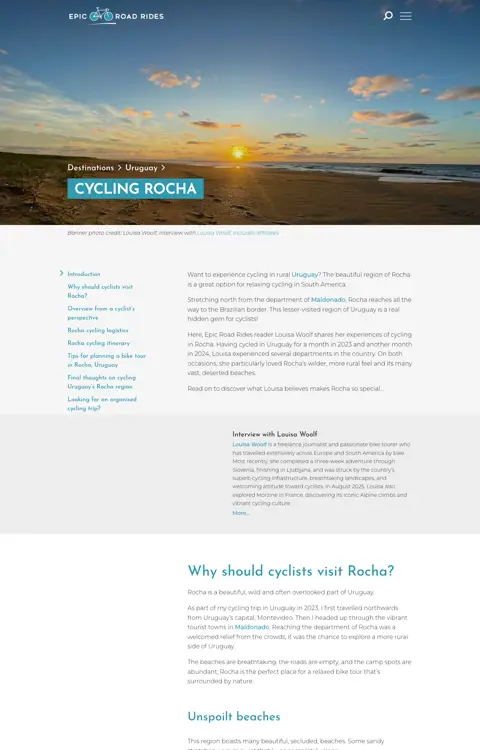
Louisa Woolf, a British journalist, rode Rocha across two research trips and turned it into the most detailed English-language guide to this coast. She splits the 251 kilometres from El Caracol to Chuy into stages — La Paloma, La Pedrera, Cabo Polonio, Punta del Diablo — with distances, road surfaces and camping notes for each, settles on December to February for the weather, and warns that a lot of businesses take cash only. The flamingos at the Laguna de Rocha, she says, are not to be skipped.
Epic Road Rides — the Maldonado guide
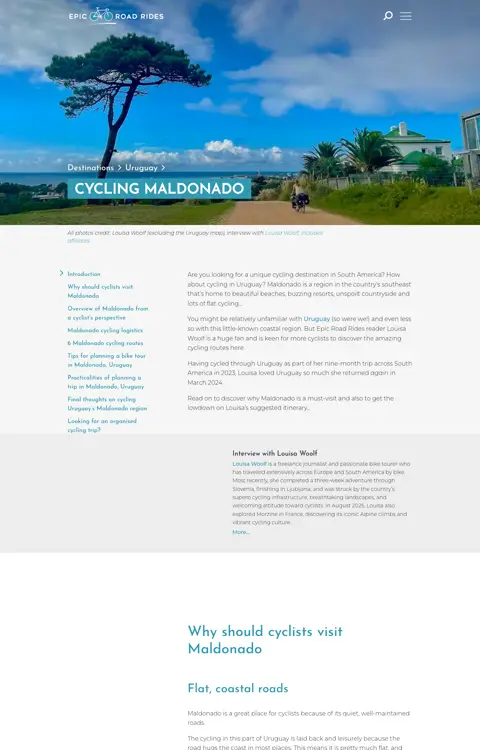
Woolf's companion guide to Maldonado gathers six linked rides — around a hundred kilometres in all — from Piriápolis and Punta Ballena out through Punta del Este, La Barra and José Ignacio to the Laguna Garzón, with an optional loop up into the sierras. The roads are paved and in good shape, the drivers notably considerate, and there are active road-cycling groups around Punta del Este. Her pick among the detours is Pueblo Garzón, a small art town whose galleries open in January and February.
Luján and Mariana — a ride from home
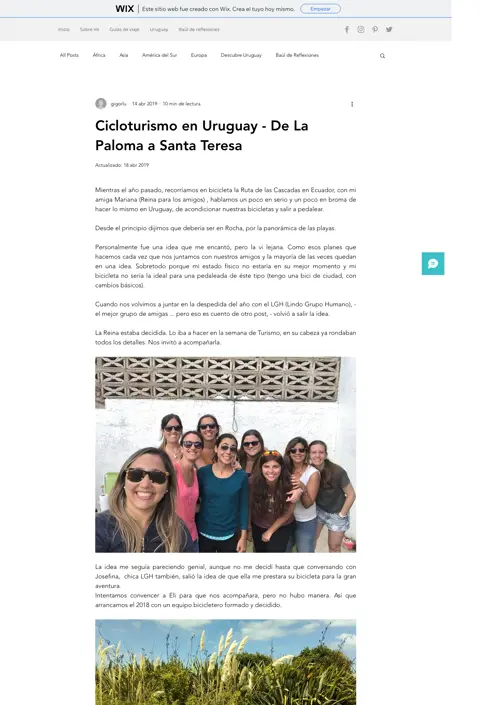
Among so many foreign accounts this is a rare Uruguayan one, and told in the first person: two women who rode 133 kilometres over four days of Semana de Turismo, from La Paloma to Santa Teresa by way of La Pedrera, Barra de Valizas and Punta del Diablo. They walked the steep climbs near Castillos rather than grind up them, came upon an empty, undeveloped beach by chance, and kept a careful tally of where they slept — Point Hostel in La Pedrera at twenty-one dollars a night, Valizas Hostel at eighteen, Mar de Fondo in Punta del Diablo at fifteen.
Epic Road Rides — the overview
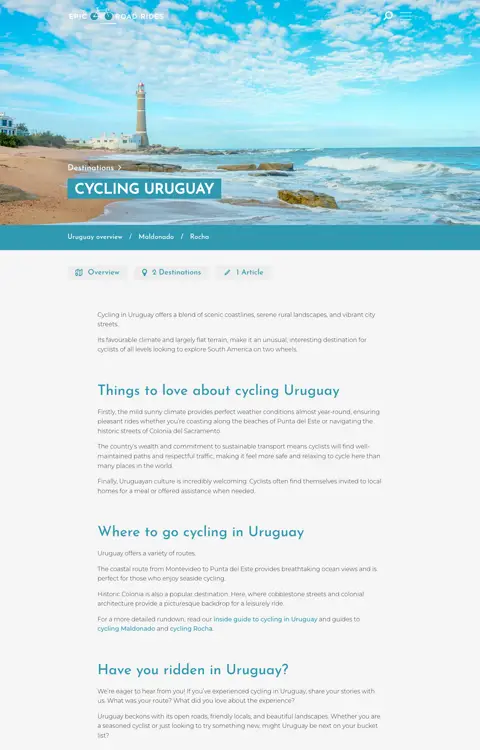
Behind the two departmental guides sits Woolf's overview page — the place to begin if you want the whole country before the detail. It sketches a temperate climate, flat and forgiving terrain, and a cycling culture she found welcoming; there is less depth here than in the Rocha and Maldonado guides, but it shows how the pieces fit together.
Revista Bicicleta — a family trip

This Brazilian account covers roughly seven hundred kilometres from Chuí to Montevideo, ridden by a writer alongside his sixty-nine-year-old uncle — a trip measured in generations rather than against the clock, with rest days taken at Cabo Polonio and again in Montevideo. As the account has it, the ride ran to about fifteen days, ten of them actually in the saddle, into a stiff minuano — the cold, dry wind that sweeps up off the pampas — much of the way.