Slow cycle-touring — what it means here
A bicycle read as a way of knowing a place at the right speed — not a machine for going fast. Why Uruguay suits it, and what these pages set out to document.
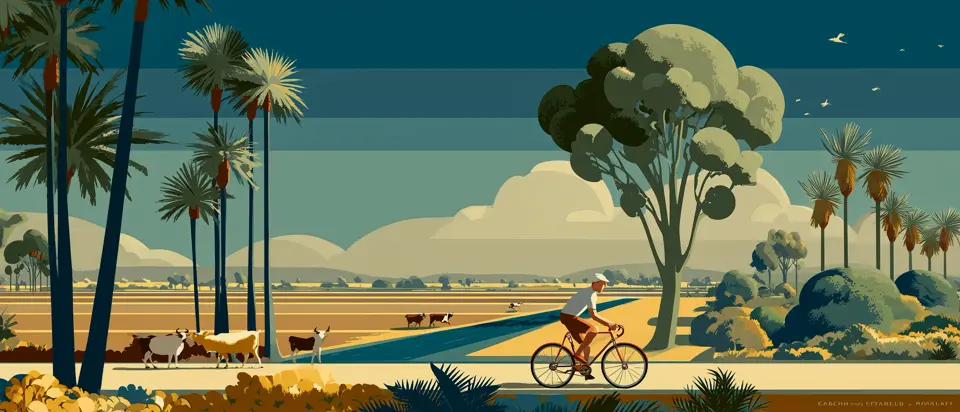
Most talk about bicycles circles around speed — gears, times, watts, the next personal best. Slow cycle-touring starts from the opposite instinct. It asks the bike to do something quieter: to move at the pace of a place, and let you take it in.
That pace is the whole point. A car carries you through a landscape faster than you can absorb it; the windscreen flattens a country into scenery. On foot you miss nothing, but you cover so little ground that a whole region stays beyond reach. A bicycle falls between the two — quick enough to join up real distance in a day, unhurried enough that the eucalyptus still reaches you, the road still tilts under you, and you notice where the surface changes and where the birds change with it. You get somewhere having genuinely crossed everything in between.
Nor is the idea homegrown. The United States has had an institution for it since 1974: the Adventure Cycling Association, which for half a century has charted long-distance routes and put touring guides into riders' hands. The web has its own hub for it now in Bikepacking.com, where route notes and trip journals from every continent sit side by side. Uruguay earns a place in that company — the practice suits the country, rather than the country borrowing the practice.
And it is unusually well suited to the idea. More than six hundred kilometres of coastline, an interior of gentle rolling country with no mountains to speak of, distances a rider can genuinely take on — and, slowly, the infrastructure to match. The coastal bike path through Ciudad de la Costa, whose final stretch opened in late 2025, is the newest piece of ground built for exactly this kind of riding.
That is what this section sets out to document: Uruguay at cycling pace — the routes, the country they cross, and the people already riding them.
- Adventure Cycling Association — About Adventure Cycling. adventurecycling.org. US long-distance cycle-touring institution, founded 1974: route mapping, guides, magazine.Accessed 3 · JUL · 2026
- Bikepacking.com — About Bikepacking.com. bikepacking.com. Global archive of route guides and ride journals.Accessed 3 · JUL · 2026