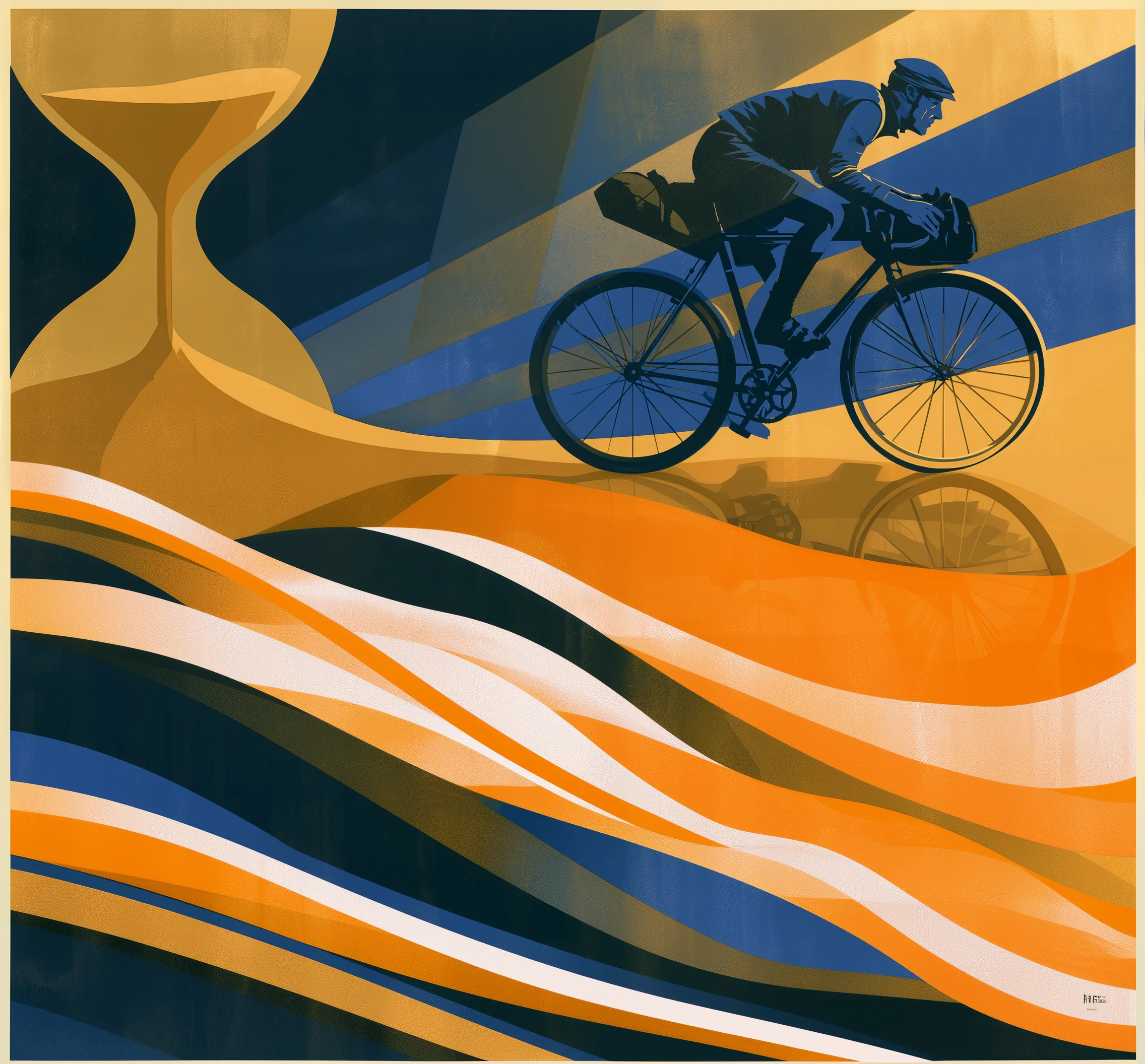
Riding the Rambla
If you have time for one ride in Montevideo, make it the waterfront. A protected ribbon follows the río for kilometres, from the old port out toward Pocitos — the simplest, surest way to feel the city from the saddle.
Every city has one ride that explains it. In Montevideo it is the Rambla — the waterfront avenue and promenade that traces the southern edge of the city, and the closest thing it has to a shared outdoor room. Montevideanos treat it as a backyard: they walk it, fish from it, drink mate on its wall at the end of the day. On a bicycle it becomes something else again — a single line along the water that lets you read the city barrio by barrio without once consulting a map.
The río is not the sea, but it behaves like one. It is wide enough that the far shore disappears, brown with the sediment its name never admits to, and on a clear evening it turns the same copper as the streetlights coming on. The path is flat — almost entirely flat — for its full length. There are no climbs to speak of and little reason to hurry. This is cycling at the pace that makes a city legible: slow enough to notice.
The protected riding begins at the Escollera Sarandí, the breakwater at the edge of the Ciudad Vieja, and follows the coast east. For its first stretch — about 4.7 kilometres, opened in 20241 — it is a two-way lane laid on the roadway itself, screened from cars by a line of parked vehicles rather than a kerb.2 Where that lane ends, near the Parque Rodó, an older path set apart from the road picks the route up without a break and carries it through Punta Carretas and Pocitos as far as the naval prefecture. Between the Ciudad Vieja and the prefecture you stay clear of traffic the whole way — close to eight kilometres of it, enough for an unhurried morning, out and back.
It is worth knowing where the easy riding stops. Past the prefecture in Pocitos the protected path runs out, and from there east — Buceo, Malvín, Punta Gorda, Carrasco — the Rambla is shared with traffic. It is still ridden daily by Montevideanos who know it, but it asks more of a visitor and is not the place to start. The city has been extending its protected network avenue by avenue, working toward the day the whole coast is its own; for now, the western half is the ride to come for.
You can ride a great deal of Uruguay and remember the empty interior roads and the Atlantic coast the longest. But the Rambla is where most visitors begin, and it is the right place to begin.
A few practical things, then. The modern stretch is two-way, so keep right and expect oncoming bikes, runners and the occasional scooter; it is busy and good-natured, not a place for speed. Ride east in the morning with the sun at your back, or west in the late afternoon, into the sunset Montevideanos plan their evenings around. Rental shops can be found in the Ciudad Vieja and around Pocitos, and the whole protected stretch and back makes a comfortable couple of hours with stops. Bring water and something for the sun — there is very little shade between you and the río.
- Intendencia de Montevideo. "Con la nueva ciclovía de la rambla, Montevideo alcanza casi 80 km de infraestructura para bicicletas." montevideo.gub.uy, 21 Sept 2024.Accessed 17·VI·2026
- El Observador. "Modelo Quijano, velocidades y controles: todos los detalles de la ciclovía de Rambla Sur." elobservador.com.uy, 24 Apr 2024.Accessed 17·VI·2026