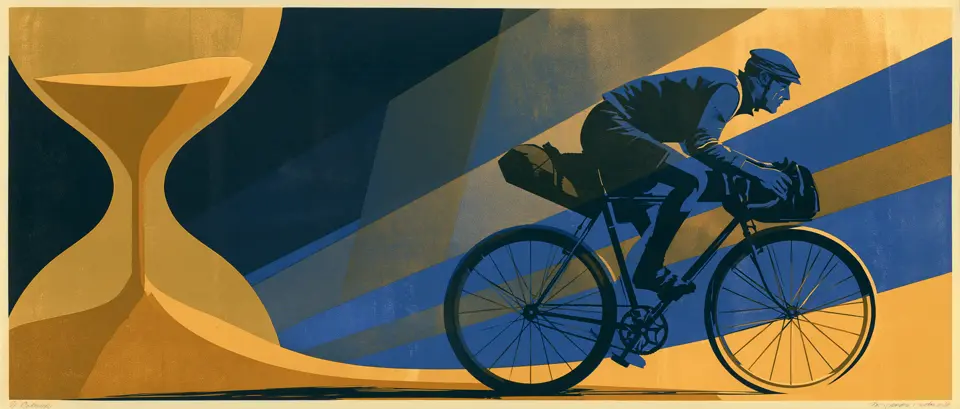
Ciudad de la Costa: the corridor that took more than a decade
Today you can ride, without a break, almost thirteen kilometres along the Ciudad de la Costa shore, from the Arroyo Carrasco to El Pinar. Seen that way, all of a piece, it looks like a single project. It isn't: it's the sum of many small ones, built in stages, over more than a decade. The story of that corridor isn't the story of an inauguration — it's the story of patience.
There are two ways to tell an infrastructure. One is the photo of the day the ribbon is cut: the governor, the officials, the gleaming new stretch. The other is the film: how it got there, stretch by stretch, year by year, government after government. The Ciudad de la Costa coastal corridor is better understood through the second. Because it wasn't inaugurated: it got made, bit by bit.
How it was built, in stages. The first stretch opened in February 2015: a little over a kilometre, with its bike lane, along the shore.1 That same year the Racine bike lane was added. In December 2017, with several pieces already done, a mid-corridor stretch was inaugurated — and the departmental governor of the day, Yamandú Orsi, acknowledged that the bike lane lacked "absolute continuity": it was still a string of disconnected stretches. In 2018 came the aerobic circuit; in 2019, the Alvear bike lane; and by 2020 the Rambla del Paseo Costero was finished, some twelve kilometres of it. What remained was the hardest part: the end, the one that reaches the border with Montevideo. That last work started in November 2023, added about another kilometre in December 2024, and closed in November 2025, when the final 3.6 kilometres carried the corridor to the Arroyo Carrasco.2 About eleven years between the first stretch and the last.
- First stretch (~1 km) on the shore
- The Racine bike lane is added
- A mid-corridor stretch; officials admit it still lacks continuity
- The aerobic circuit
- The Alvear bike lane
- The Rambla del Paseo Costero is complete (~12 km)
- Work begins on the final stretch
- One more kilometre (Calcagno–Ecuador)
- The last 3.6 km reach the Arroyo Carrasco
What Canelones did. This corridor wasn't built by Montevideo, nor by a metropolitan plan, nor by some great act of the State. The departmental government of Canelones put it together, piece by piece, along its own shore, across two administrations of the same political stripe. And it's worth being honest about how: not as a tidy, fully-funded cycling master plan, but as a sum of stretches that rode along on road, sanitation and financing works as they came up. Sustained aspiration, opportunistic execution. Either way, the result is one of the country's few continuous cycling infrastructures built entirely by a department that isn't the capital.
Infrastructure as process. This is what the corridor teaches, and what the inauguration photo hides: cycling networks don't appear, they accumulate. They're built stretch by stretch, budget by budget, with the sustained will of several terms of government — because no single one is enough to finish it. What on today's map looks like a continuous line was, in fact, a decision taken and re-taken over years. Patience isn't a flaw in the process: it is the process.
The stretch missing on the other side. And yet the corridor doesn't quite close. When it reaches the Arroyo Carrasco, the border with Montevideo, it runs into the hole: on the capital's side, between Pocitos and Carrasco, there are about fourteen and a half kilometres of rambla with no cycling infrastructure.3 Canelones finished its part; on the Montevideo side, the continuity still waits. The corridor that took more than a decade to build on the Canelones side has, on the Montevideo side, not really begun.
What the wait teaches. More than ten years is a long time for thirteen kilometres. But that slowness says something more encouraging than it seems: that serious cycling infrastructure can be built in Uruguay, even if bit by bit, even if it's a department without the capital, even if it takes longer than anyone would like. The Ciudad de la Costa corridor exists because someone decided, over and over, to keep building it. That is, in the end, the only way these things get finished: not overnight, but stretch by stretch, until one day the map shows a whole line. On the Canelones side, that line is already there. What's left is for the other side of the border to make the same decision.
- The early stages (2015–2020). The first stretch opened 11 Feb 2015: Montevideo Portal, "Inauguran tramo del Paseo Rambla Costanera en Ciudad de la Costa"; the Racine bike lane (imcanelones.gub.uy); Dec 2017, intendente Orsi acknowledged the lane lacked continuity: El Observador, "Ciudad de la Costa inauguró un nuevo paseo costero" (full sentence: "Si bien no hay continuidad absoluta, es una especie de prolongación de lo que acertadamente se ha hecho en Montevideo"); the aerobic circuit 2018 (imcanelones.gub.uy), the Alvear lane 2019 (imcanelones.gub.uy), and by 2020 the Rambla del Paseo Costero (imcanelones.gub.uy) (~12 km).Read 27·VI·2026
- The final stretch (2023–2025). Works began Nov 2023: Intendencia de Canelones, "Comenzó construcción de un nuevo tramo del Paseo Costero"; +1 km (Calcagno–Ecuador) Dec 2024: "Intendencia inaugura obras de consolidación, accesibilidad y movilidad sostenible"; closed with the final 3.6 km to the Arroyo Carrasco Nov 2025: "Nuevo tramo del Paseo Costero conecta Canelones y Montevideo".Read 27·VI·2026
- The corridor and the hole. ~12.7 km continuous Arroyo Carrasco → El Pinar (own survey + the IM Canelones release above); ~14.5 km of unprotected MVD rambla (Pocitos → Arroyo Carrasco) verified by its absence from the Bicicircuito map (Intendencia de Montevideo) + our field survey — so no protected Ciudad Vieja → El Pinar continuity.Read 27·VI·2026