Anti-theft basics: locks, and where not to leave the bike
Fear of theft keeps more bikes in the garage than any hill or any rain. Let's say it straight: no lock is unbreakable, and a determined thief with the right tool beats any of them. But that isn't the game. The game is to make your bike a worse target than the one next to it, and to slow the opportunist past the point of bothering. With method — not paranoia — the risk drops enormously. Here's the method.
Bike theft in Uruguay isn't published as a separate figure — there's no official statistic for it — but anyone who rides in Montevideo knows it happens, and that a single lapse costs you the bike. So let's start with the principle that orders everything else: a bike's security isn't a yes-or-no question, it's a question of how much. There's no such thing as an unstealable bike; there's the bike that costs too much time, too much noise or too much tool to be worth it next to the one beside it. Almost everything that follows aims at that: pushing the cost of the theft above the prize.
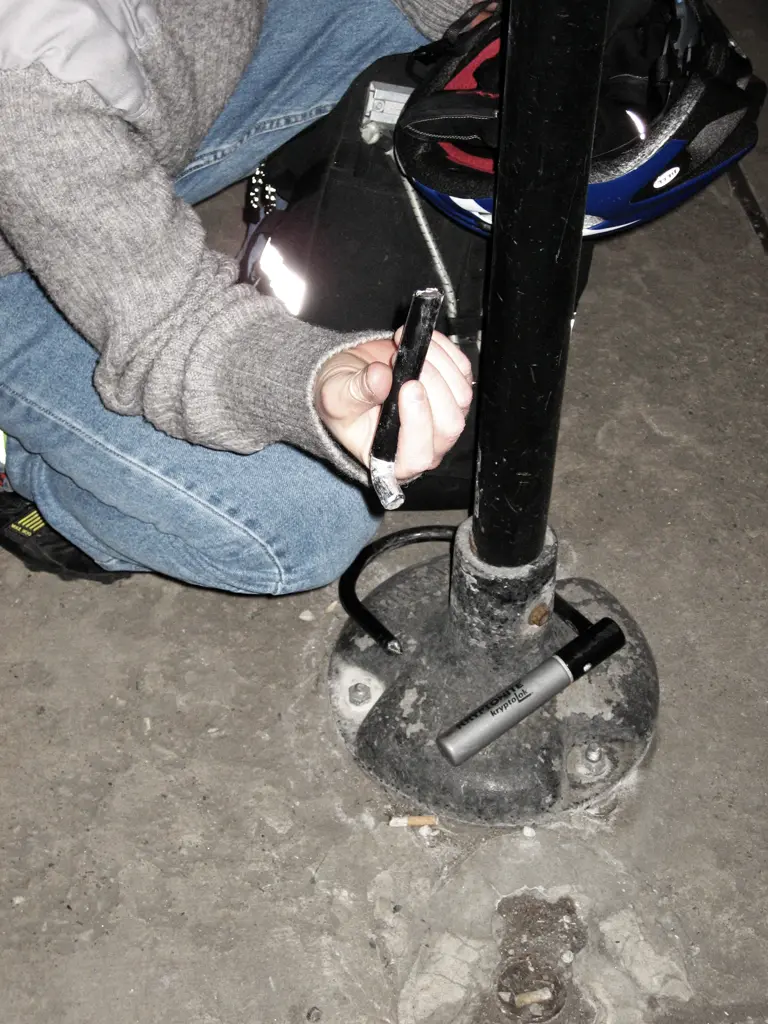
No lock is unbreakable: even a U-lock yields to the right tool. That's why the game is time and cost. Photo David B. Gleason · CC BY-SA 2.0 · Wikimedia Commons
The lock: which kind works and which doesn't. It's the most underrated decision, and the place most money is wasted by not spending it. The options, from least to most:
- A thin cable is, basically, decorative. It's cut in seconds with a small hand tool. It stops someone wheeling the bike off in one motion, and nothing more. Don't trust a bike you care about to one.
- The U-lock (or D-lock, the rigid shackle) is the standard and the most advisable choice for the city: hard to lever, compact, and the best security-to-price ratio.
- A hardened chain is heavy but flexible: good for locking to awkward objects where the U won't reach, and a deterrent by its sheer thickness. The kind that works is hardened-link, not a hardware-store chain.
- The folding lock is a middle ground: more flexible than the U, more secure than the cable, more expensive.
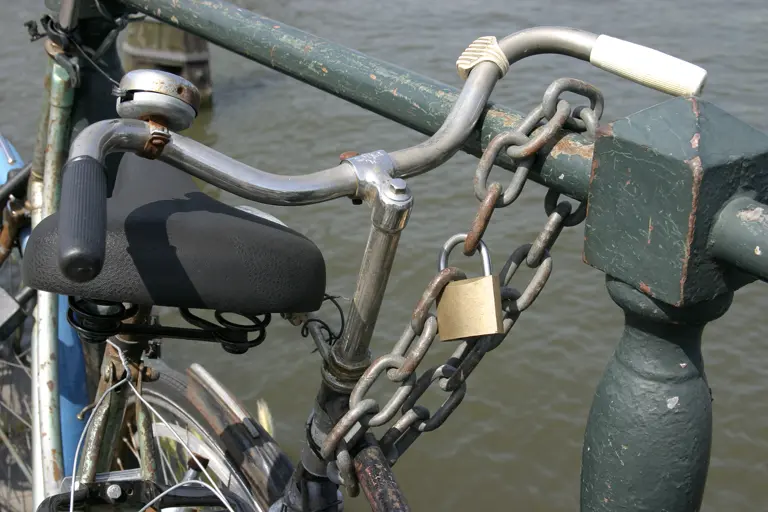
The hardened chain: heavy but flexible, for locking where the U-lock won't reach. Photo Nino Barbieri · CC BY-SA 2.5 · Wikimedia Commons
The honest rule: spend a sensible fraction of the bike's value on the lock. A cheap lock on a good bike is a contradiction — and you pay that bill only once. A note from the local market: the best-known international brands aren't always available here and often have to be imported, so for most people the realistic choice is a big store's own line or a good generic U-lock of decent thickness.
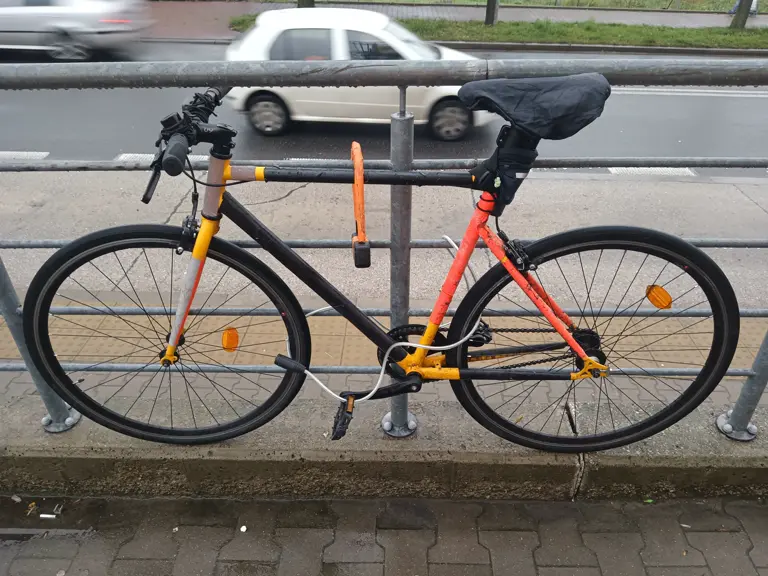
The goal: frame and wheels secured to a fixed point, U-lock and cable combined. Source WrS.tm.pl · Wikimedia Commons · Public domain
How to lock up properly: the part almost everyone gets wrong. Having a good lock isn't enough; you have to use it well, and this is where most bikes are lost:
- Lock the frame, not just the wheel. If you secure only a wheel, the thief releases it and walks off with the rest. The frame is what has to stay captive.
- Lock the frame and the rear wheel together to a fixed object. The classic trick: pass the lock through the rear triangle of the frame and the back wheel at once — even if they cut the rim, the wheel won't come out of the frame.
- Fill the empty space in the U. The less gap left inside, the less room there is to insert a lever and force it.
- Keep the lock off the ground. Resting against the pavement, the ground gives the thief leverage to smash it in one blow.
- Lock to something that can't be cut or lifted over. A solid bike anchor — not a flimsy sign that unscrews, not a sapling you can lift the bike over, not a rickety railing.
- A front quick-release wheel and a quick-release saddle are an invitation. If they come off without a tool, take the saddle with you or secure them with a second lock or cable.
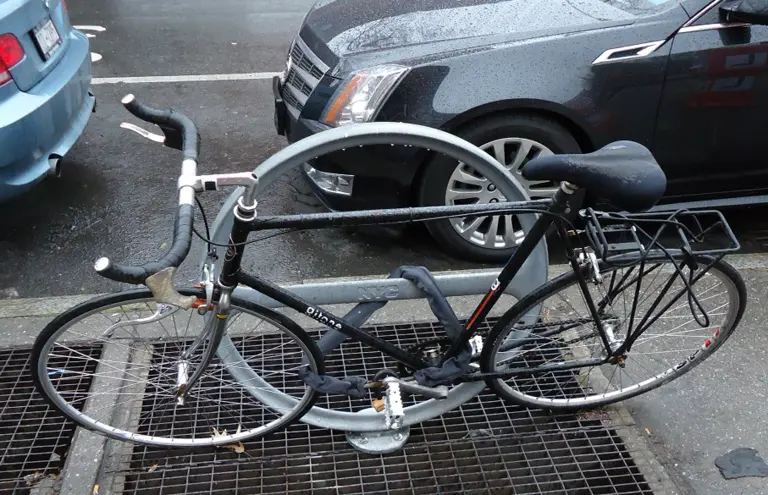
Lock to a fixed anchor, in plain sight with people around: the best free lock there is. Source Tomwsulcer · Wikimedia Commons · CC0
Where not to leave the bike. The spot matters as much as the lock, because it decides how much time and how much privacy the thief has to work:
- Don't leave it on the street overnight. Time is the thief's ally, and night hands over the two things they need: hours and solitude. It's the single biggest risk multiplier there is.
- Don't leave it in isolated, empty, badly-lit places. Theft wants privacy; other people's eyes are the best free lock there is.
- Don't always leave it in the same place at the same time. Routine lets them study you and come prepared with the right tool.
- Don't lock it to something removable. A sign that comes apart, a loose railing or a free-standing pole turns the best lock into an ornament.
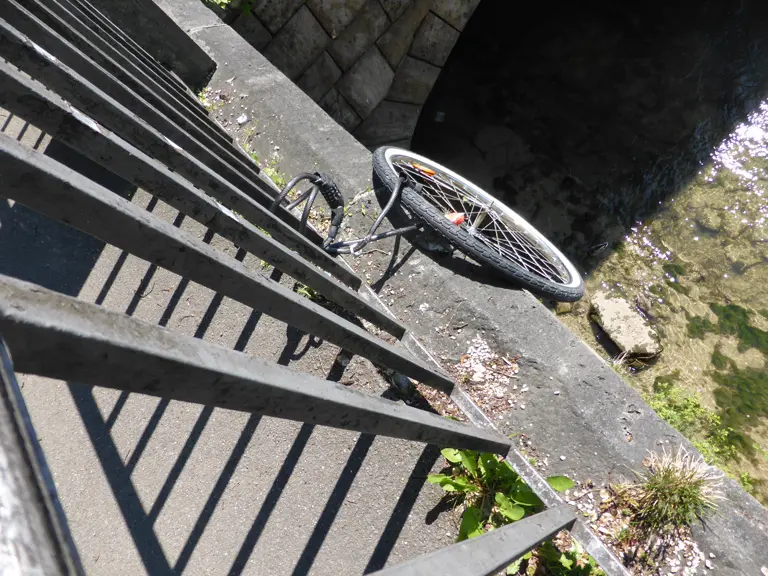
What a lapse leaves behind: a stripped frame. Most bikes are lost to where and how they were left. Source MartinThoma · Wikimedia Commons · CC0
The flip side is the obvious one: busy places, in plain sight, well lit; the bike parking when there is one; and, whenever possible, indoors and under a roof. A bike that sleeps inside is one no one steals.
Register and mark the bike: the recovery insurance. This doesn't prevent the theft, but it completely changes what happens afterwards. Photograph your bike, write down the frame serial somewhere — the number engraved, usually under the bottom bracket — and keep the purchase receipt. With that, if the bike turns up — in a search, at a flea market, in a resale listing — you can prove it's yours and the police can return it. Without a frame number or a photo, a recovered bike belongs to no one. In Uruguay there's no official registry where you can record your bike in advance, so you build that file yourself; and if it's stolen, the police report with those details is the legal record that remains.
The right attitude: method, not paranoia. You can't make a bike unstealable, and living in fear isn't the idea — keeping the bike locked away just in case is losing it another way. A good lock used well, a thought-out spot, and the minimum recovery prep turn your bike from an easy grab into a bad bet, and that's almost all the protection there is. The rest is riding the bike — which is what it's there for.
- Decathlon Uruguay — bike accessories: own-brand (B'Twin) chain and folding locks, roughly ~$2,100–$3,200 Uruguayan pesos. Prices volatile — check the current one.Read 30·VI·2026
- MercadoLibre Uruguay — bike locks and U-locks: a wide range — cables ~$200–500 (minimal security), generic U-locks ~$500–1,000, mid-range chains and folding locks ~$2,000–3,000 Uruguayan pesos. Prices volatile — check the current one.Read 27·VI·2026
- A note on the data: Uruguay publishes no bike-specific theft statistic (the Ministerio del Interior records theft reports without a per-object breakdown), and there is no official bike registry or marking program from the Intendencia, UNASEV or the police — so this piece treats the topic qualitatively and recommends keeping your own record.Read 27·VI·2026